What the card shows
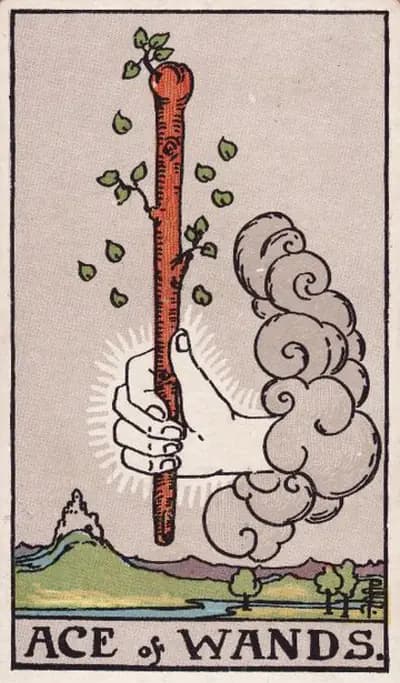
A hand reaches out of a grey cloud holding a sprouting wooden wand; green leaves drift down above a river and a castle on a hill.
Pamela Colman Smith brings the hand out of a grey cloud on the right, inside a white halo. All four Aces in the deck show this hand from elsewhere: the force is given, not made. The staff is not carved. It is a living branch, with shoots still breaking out of the wood. Every Wand in the suit keeps its leaves, a sign of a fire that makes things grow rather than burn. Loose leaves drift down through the air. Many readers see in them the yod, the small flame-shaped Hebrew letter. Below lie a castle on its hill, a river and a few trees: quiet country, still far from the hand. Nothing has been built near the staff. Everything is still to do.
Ace of Wands upright
An idea has hold of you and won't let go: a project, a desire, an urge to begin. Don't lock it inside a perfect plan. Take the first step this week, even a small one, while the impulse is still warm in your hand.
Upright, the Ace of Wands is a beginning that comes from inside. You want to write that piece, open that small online shop, go back to dancing, pitch your idea at the next meeting. The wish arrives before the plan, and that is normal. Waite files creation, invention, enterprise and the birth of a thing under this card.
The tradition reads the Ace as a root: all the force of Fire, with no shape yet. The card does not promise it will work. It says the drive is real and will not stay warm for long. The right use is one concrete act while your hand still holds the staff: book the room, send the email, buy the notebook. What follows gets built in the next cards, from the Two to the Ten.
Ace of Wands reversed
The wish is there but nothing catches: you postpone, you doubt, or you scatter in ten directions. Pick one thing and give it an hour. If the spark won't hold, maybe it was never yours.
Reversed, the fire is there but nothing catches. You have had the idea for months and keep pushing it to Monday. Or you have ten ideas and hop between them without finishing one. The energy circles instead of getting out. Sometimes the wish was never yours: a plan someone else talked you into that does not really warm you. Waite, in 1910, read the reversed Ace more harshly, as a fall or a clouded joy. Our reading stays simpler: the drive is blocked, and the real question is what is blocking it.
In love
In love, the Ace of Wands speaks of desire and the wish to live something. An attraction just starting, a first date, the urge to suggest a weekend away together. In a relationship it is a revival: wanting to surprise your partner, to bring play back into ordinary evenings. The card describes the spark, not how long it lasts. To know whether it holds, you will need more evenings than the first.
Work and money
At work, this is the idea that arrives before the budget. A side project, an unsolicited application, an offer you want to launch. The card suggests testing small before planning everything: a one-page site, a first client, a rough prototype. On money, Waite lists fortune among the possible senses, but the Ace promises no gain. It says energy is available. Turning it into income is your part.
As advice
Make one move this week, however small, that makes your idea real. Do not wait for the perfect plan: a flame kept out of the wind for too long goes out anyway. Write the idea down, show it to one person you trust, and see whether it still warms you the next day.
Astrology and tradition
The Golden Dawn gives the Aces no decan. Book T calls this one the Root of the Powers of Fire. The Aces turn around the pole, above the zodiac: they hold the whole element before it is shared out among the signs. The Ace’s Fire feeds Aries, Leo and Sagittarius, which the Two to the Ten will travel through in turn. For Book T, an Ace is always a strong card.