What the card shows
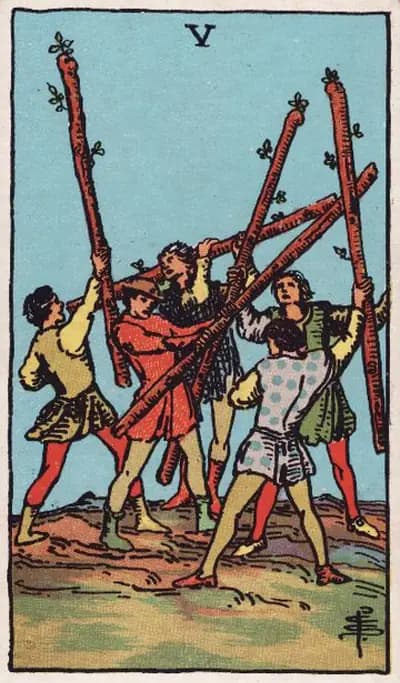
Five young men in colourful tunics raise long wooden staves that cross each other under a blue sky, on rough, uneven ground.
Five young men raise long staffs that cross one another. No two tunics are alike: each defends his own colour, his own idea. Yet no one is hurt, and no staff really lands. Waite calls it mimic warfare, a sham fight, like sport or training. The ground is uneven: nobody fights on level terms, each has an edge and a weak spot. There is no leader and no winner in the picture. The staffs make a tangle where you can no longer tell who is aiming at whom. It is the exact image of a meeting where everyone is right at once.
Five of Wands upright
Around you, everyone is defending their own idea and talking at once. This friction is not a war: it can sharpen you. Say clearly what you think, listen to the answer, and keep the game fair.
Upright, the Five of Wands describes a situation where everyone pushes their own idea. A meeting that turns into a debate, friends who cannot agree on a date, a shared flat where each person has their own rules. Waite reads strife, competition, imitation and the struggle for gain. It is noisy and tiring, but rarely serious.
The tradition reads this friction as useful. A plan nobody ever challenged stays fragile. Debate forces you to sharpen what you think, find better arguments, hear other people’s. The card only asks that the game stay fair. State your position clearly, once, without raising your voice. Listen to the reply all the way through. And notice who is trying to move forward and who only wants to win.
Five of Wands reversed
The disagreement turns serious: people are really fighting now, and someone isn't playing straight. Keep a record, reread what you sign, don't answer in the heat of it. If it goes beyond talking, ask someone whose job it is.
Reversed, the disagreement takes a more serious turn. Waite reads disputes, litigation and trickery here, and the printed meaning follows that line: someone is not playing straight. The game has stopped being a game. Our voice adds the inward side: you may also dodge conflict so much that others end up deciding for you. Keep written records, reread what you sign, do not answer in the heat of the moment. If it goes beyond talking, ask advice from someone whose job it is.
In love
In love, the Five of Wands means bickering and tension over practical things: who does what, whose family for the weekend. It is not necessarily a bad sign. A couple who dare to disagree are often more alive than one that goes quiet. Single, the card can show competition, or too many opinions around you. Listen to your own.
Work and money
At work, this is the card of lively meetings, tenders, competition between colleagues or between companies. It asks you to defend your case with facts, not ego. On money, it can show a crowded market where you need to stand out. Save your energy for the debates that truly matter.
As advice
Say what you think, clearly, once. Hear the answer before you reply. Pick the fights that serve the project, not the ones that serve your pride. A disagreement handled well can leave an idea better than the one you started with.
Astrology and tradition
The Five of Wands is Saturn in Leo, 0 to 10 degrees. Book T starts the round of planets through the minor cards at this very decan. Saturn sets limits and rules. Leo wants to shine and be recognised. The two rub against each other. Book T names the card Lord of Strife. The number five is opposition and obstacle. Whether it ends in success or failure shows in the cards around it.