What the card shows
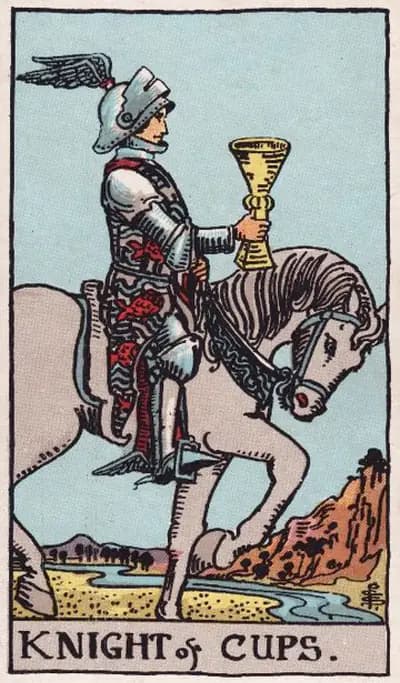
A knight in a winged helmet rides a white horse at a slow walk, holding a golden cup out before him; a river runs beneath ochre cliffs.
A knight in armour rides a white horse at a walk. Waite describes him as graceful but not warlike, riding quietly. He wears a winged helmet and wings at his heels, like Hermes, the messenger of the gods. For Waite, the winged helmet points to the higher graces of the imagination. Red fish on his tunic recall the water of his suit. He holds the cup upright before him, carefully, as if he did not want to spill a drop. The horse lowers its head, calm. Ahead of them runs a river that will have to be crossed, below the cliffs. Waite adds that this knight, too, is a dreamer.
Knight of Cups upright
Someone is approaching you with a sincere offer, or you are the one wanting to reach out. Move without rushing: say what you feel gently, and let your heart choose the direction rather than your calculations.
Upright, the Knight of Cups is a sincere approach. Someone is coming toward you with an offer: a date, a collaboration, a reconciliation. Or you are the one wanting to reach out. Waite gives arrival and approach, sometimes that of a messenger, and also advances, a proposition, an invitation.
Like every Knight, the card speaks of movement. But this movement comes from the heart, not from ambition. The knight forces nothing. He moves at his own pace and leaves the other person free to take the cup or not. In practice, this is the moment to say what you feel gently, accept an invitation that touches you, follow a creative urge. Let your heart choose the direction rather than your calculations.
Knight of Cups reversed
Lovely words that lead nowhere: a promise that never takes shape, or your mood shifting from hour to hour. Before dreaming up what comes next, look at what is actually being offered.
Reversed, the Knight of Cups keeps the lovely words, but they lead nowhere. A promise that never takes shape, passionate messages followed by silence, a mood that shifts from hour to hour. Waite read the reversed card more harshly: trickery, duplicity, fraud. In our reading, the heart's impulse stays stuck in the dream. It may be the other person, or you. Before imagining what comes next, look at what is actually being offered. A real promise shows itself in what follows, so give it a little time.
In love
In love, the Knight of Cups is the card of romance. A declaration, an invitation, someone making the first move with care. In a couple, it invites you to bring back the gestures of courtship: a letter, an evening planned with thought. The card does not say this person is the one. It says the impulse is sincere. Watch whether it lasts beyond the first words.
Work and money
At work, the Knight of Cups speaks of an offer you like: a creative project, a job in a field you love, a warm collaboration. It is a good card for artistic work, diplomacy and mediation. With money, it advises checking the details of an attractive offer before you say yes.
As advice
As advice, the Knight of Cups asks you to move with your heart, without rushing. Take that step toward the other person. Say things gently. And when someone makes you lovely promises, wait to see what they do before dreaming of what comes next.
Astrology and tradition
The Knight of Cups corresponds to Fire of Water. In the Golden Dawn system, the mounted figure is the fiery part of its element: movement and drive. Here, fire sets water moving: emotion gets going, a feeling becomes an approach. Book T calls this figure the Lord of the Waves and the Waters. Court cards carry no number: they describe a way of acting.