What the card shows
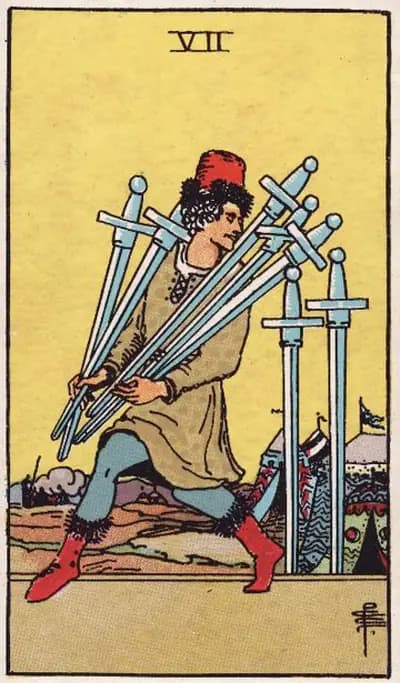
A man in a red cap tiptoes away with five swords in his arms, glancing back; two more swords stay planted near the tents under a yellow sky.
A man in a red cap tiptoes away with five swords clutched in his arms. His arms are too full for him to defend himself. He looks back over his shoulder with a smile: he knows someone could see him. Two swords stay planted in the ground. Behind him stands a camp of tents with pennants, and in the distance a small group by a fire notices nothing. The yellow sky gives the scene a broad-daylight air. Waite describes a man carrying swords away in haste, close to a camp. The tradition reads boldness, cunning, and a plan not quite finished.
Seven of Swords upright
You're moving alone and not announcing everything, and that may be right. Keep your plan to yourself while it ripens, but check one thing: are you working around an obstacle, or avoiding a conversation you need to have?
Upright, the Seven of Swords describes action taken alone and quietly. You prepare a job change without mentioning it, you work around a pointless rule, you keep an idea to yourself while it takes shape. Waite reads design, attempt and hope here, and also a plan that may fail.
The card is not a moral verdict. Discretion sometimes protects what is still fragile. But it asks for an honest check: are you working around an obstacle, or avoiding a conversation you need to have? It can also warn you about someone acting behind your back, or about the pull to take more than your share. The two swords left in the ground are a reminder that you cannot carry everything.
Seven of Swords reversed
What you kept hidden weighs more than expected, or comes out anyway. You may want to set the swords down and speak plainly: it is often lighter than carrying it all alone.
Reversed, the Seven of Swords shows that what was hidden weighs more than expected. A secret comes out, or you feel it is time to set the swords down and speak plainly. Carrying a plan, a lie or an omission alone is more tiring than it looks. Waite, in 1910, read good counsel here, but also slander and babbling. The card invites you to seek the view of someone you trust, and to be wary of rumours, the ones brought to you and the ones you might pass on.
In love
In love, the Seven of Swords speaks of what is left unsaid: a hidden feeling, a hesitation, a part of life one person keeps to themselves. It does not prove betrayal. It signals a lack of openness, in the other person or in you. If you are single, it can point to an attraction you are keeping secret. The question is: what would make honesty possible?
Work and money
At work, the card favours strategy: preparing a project quietly, negotiating without showing every card, choosing the right moment to announce. It also warns about underhand moves and ideas taken without credit. Keep written records of your work. With money, it advises reading the small print and checking what you are promised.
As advice
The Seven of Swords as advice: be strategic, but stay honest with yourself. Keep your plan private if it needs time. Then ask what you are avoiding by keeping quiet, and whether a frank conversation would not weigh less.
Astrology and tradition
Book T calls this card the Lord of Unstable Effort. Its decan is the Moon in the last third of Aquarius. The Moon changes constantly; Aquarius is independent and unpredictable. Together they give an effort that comes and goes, and plans that change on the way. Seven is the number of a possible result that depends on the next action: nothing is settled, everything depends on what you do next.