What the card shows
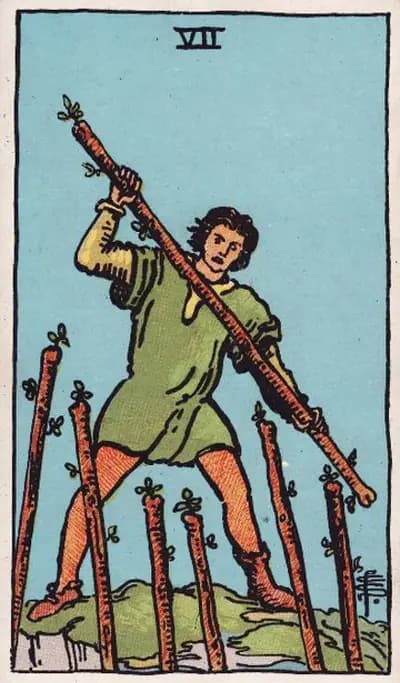
A young man in a green tunic stands on a mound, gripping a staff with both hands against six others rising from below; he wears two mismatched shoes.
A young man in a green tunic stands on a mound. He grips his staff with both hands, held across his body to block the blows. Six other staffs rise toward him from the bottom of the picture. We never see who holds them: the pressure is faceless, like a group or a rumour. Waite puts it plainly: six attack one, but the one has the advantage of height. One detail raises a smile: he wears mismatched footwear, a boot on one foot and a shoe on the other. Many readers see someone caught off guard, forced to defend himself with no time to get ready. He holds anyway.
Seven of Wands upright
Someone is questioning your place, your choice or your word, and you feel alone holding it. Yet you are on higher ground: you know this better than those pushing you. Stand firm, answer one objection at a time, and don't justify yourself more than needed.
Upright, the Seven of Wands comes when you have something to defend. A colleague questions your work, your family argues with your life choice, a group pushes in a direction you refuse. You feel alone holding the line. Waite reads valour, the advantage of height, competition and debate.
The card reminds you that you are on the high ground: you know your subject, your life, your decision better than the people pressing you. You do not need to beat everyone at once. Answer one objection at a time. Do not justify yourself more than needed: one clear explanation is enough, and the fifth will convince no one. For Book T, the number seven depends on the next action. The outcome is not written. It rests on how you hold.
Seven of Wands reversed
You defend everything, all the time, even what isn't worth the effort, and it is wearing you down. Or you give up just before it would have held. Pick the one thing that truly matters and let the rest go.
Reversed, defending turns into exhaustion. You defend everything, all the time, even what is not worth the effort. Every remark becomes an attack, every question a threat. Or the opposite: you give up just before it would have held, because you have no strength left. Waite gives perplexity and anxiety here, and warns against indecision. Our reading points the same way: the energy of defence turns back on you. Pick the one thing that truly matters, and let the rest go.
In love
In love, the Seven of Wands means defending your relationship or your boundaries. The people around you disapprove of your choice, or you need to restate what you accept and what you do not. The card backs you if you value this bond for good reasons. It also asks you to check that you are not defending yourself against your partner by reflex.
Work and money
At work, this is the card of a position to defend: a coveted role, a contested project, a market where competition is rising. Prepare your arguments, figures in hand. Do not scatter yourself answering every criticism. On money, it suggests protecting what you have gained rather than taking new risks right now.
As advice
Hold your ground, but choose what you defend. One clear answer is worth more than ten justifications. You have more support than you think. And if you have to let something go, let it be by choice and not from exhaustion.
Astrology and tradition
The Seven of Wands is Mars in Leo, 20 to 30 degrees, the last decan of Leo. Mars gives courage and the will to fight. Leo, a fixed sign, holds its ground and defends its honour. Book T names the card Lord of Valour. The number seven is a possible result that depends on the next action. Nothing is settled: the card leans on its neighbours.