What the card shows
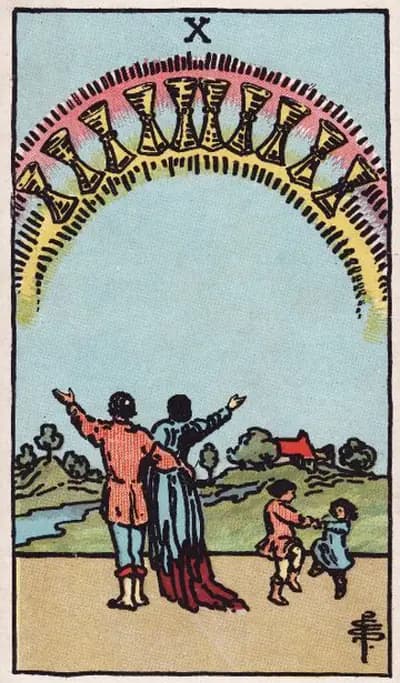
A couple seen from behind raise their arms toward a rainbow of ten cups; beside them two children dance, and a red-roofed house stands near a river.
A man and a woman are seen from behind, his arm around her. Each raises an arm toward the sky, where ten cups form a rainbow. Waite writes that they look on it in wonder. In the Bible, the rainbow is the sign of a promise after the flood: the storm has passed. Beside them, two children dance hand in hand. Waite notes that they have not noticed the marvel, but are happy in their own way. Further off stand a red-roofed house, trees, and a river winding through green hills. The happiness shown here is ordinary: a place, close ones, a clear day.
Ten of Cups upright
What you have built with your people is holding. Take the time to see it: a shared meal, a laugh, a place where you feel you belong. This happiness is not spectacular; it is here, and it grows when you notice it.
Upright, the Ten of Cups is a steady happiness. What you have built with your people is holding: a family, a couple, a group of friends, a shared flat that feels like home. Waite gives contentment, the repose of the whole heart, and the perfection of human love and friendship.
The card does not describe a magazine life. It is about a shared meal, a laugh in the kitchen, a place where you feel you belong. The family can be the one you were born into or the one you chose. Like every Ten, it marks a completed cycle: the suit of Cups reaches its end. The heart has found where to settle. This happiness grows when you notice it, and wears thin when you take it for granted.
Ten of Cups reversed
You measure your life against a perfect picture and nothing seems to match. Or a tension is simmering at home without being named. Set the ideal aside and look at what is really happening between you.
Reversed, the Ten of Cups speaks of a gap between the picture and the real thing. You measure your life against a perfect image and nothing seems to match. Or a tension is simmering at home without being named: something unsaid, a tiredness, a role one person carries alone. Waite read the reversed card as false contentment, and added indignation. In our reading the happiness has not gone, it is hidden by the ideal. Set the picture aside and look at what is really happening between you.
In love
In love, the Ten of Cups is one of the happiest cards there is. In a couple, it speaks of a solid bond, a shared plan for life, a home where everyone feels good. If you're single, it describes what you are really looking for: not only a date, a home. The card predicts neither marriage nor children. It speaks of the quality of the bond.
Work and money
At work, the Ten of Cups speaks of a place where you feel good: a close team, a balance between work and private life, a family business. It is a good card for a project that matters to the people you love. With money, it speaks of security for the household rather than wealth, and invites you to decide big expenses together.
As advice
As advice, the Ten of Cups asks you to notice ordinary happiness. Tonight, look at the people who matter to you. Thank them for one specific thing. Lasting happiness is built from small moments you actually see, not from one big moment you keep waiting for.
Astrology and tradition
The Ten of Cups corresponds to Mars in Pisces, the last decan of Pisces and of the whole Water series. Mars is a surprise in such a peaceful card. One way to read it: a completed happiness needs energy to stay alive, or it sets hard. Book T calls the card the Lord of Perfected Success. The number ten marks a fixed, complete force, for good or ill. Here, the heart is full.