What the card shows
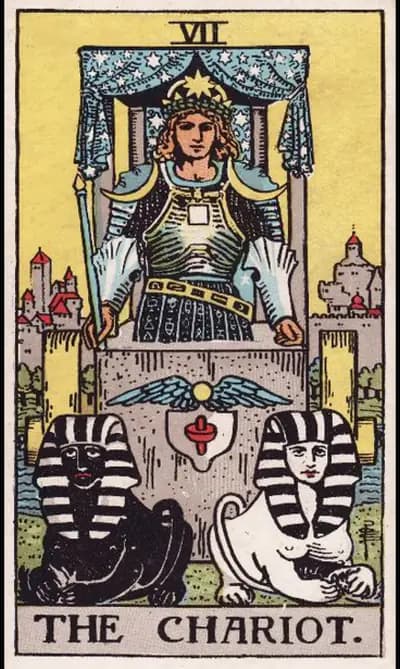
A young man in armour, crowned with a star, stands beneath a starry blue canopy; before his stone chariot rest a black sphinx and a white sphinx.
A young man in armour stands in a stone chariot, beneath a blue canopy scattered with stars. He wears a laurel wreath and a star, signs of victory. On his shoulders sit two crescent moons with human faces. On his breastplate is a square, which the tradition reads as earth and steady will. He holds a sceptre, but no reins: he does not steer his beasts by hand. Before him rest a black sphinx and a white sphinx, two opposite forces that seem to look each their own way. Behind him, a walled city and a river: he has left the shelter of the walls. Waite speaks of victory on every level, and first of all in the mind.
The Chariot upright
Two parts of you pull in different directions, and that tension is exactly what can move you forward. Choose where you are going and hold the course without gripping everything: a clear intention keeps it all heading one way.
Upright, the Chariot says you can move forward, provided you choose where you are going. A move, an ambitious project, an exam, a negotiation, a career direction to hold: the card speaks of determination and self-command. It describes the moment you gather your strength instead of scattering it.
The sphinxes matter. You don’t have to silence a part of yourself to succeed. You can keep your need for safety and your hunger for adventure, your gentleness and your ambition, and make them pull the same way. The driver has no reins: it is his will that holds the team, not control over every detail. Waite also read help, providence and triumph in this card.
The Chariot reversed
You push hard and nothing moves, or everything veers off. Before forcing more, ask whether you still know where you want to go: direction matters more than speed.
Reversed, the Chariot shows energy that strains without moving. You push harder and harder, and nothing shifts at all. Or everything veers off because each part of you pulls its own way. It is drive without direction: lots of effort, very little course, and growing tiredness. Waite, in 1910, read quarrels, disputes and defeat here. Our reading looks at the cause: before you push again, ask whether you still know where you want to go. Direction matters more than speed.
In love
In love, the Chariot speaks of a relationship that is moving, or that has to choose a shared direction. It favours plans made together: moving in, travelling, building. It warns against racing: wanting everything at once, or dragging the other person to your pace. If you are single, it asks you to know what you are looking for, rather than wait to be found.
Work and money
At work, the Chariot favours conquest: a promotion, a new market, an ambitious target. It backs people who can hold their course despite pressure from all sides. With money, it advises a clear strategy over scattered effort. Set a figure and a date, then move towards them step by step.
As advice
As advice, the Chariot asks you to write your course in one sentence. Then name the two forces pulling inside you. Look for one action that moves both of them in that direction, and take it this week.
Astrology and tradition
The Golden Dawn gives the Chariot to Cancer. Cancer is a cardinal water sign ruled by the Moon, as the crescents on the driver’s shoulders recall. The crab carries its home on its back, and the driver moves forward enclosed in his chariot and armour: a shell that lets you go out into the world. Cardinal means initiating: Cancer moves ahead, protected. The card carries the Hebrew letter Cheth, the enclosure.