What the card shows
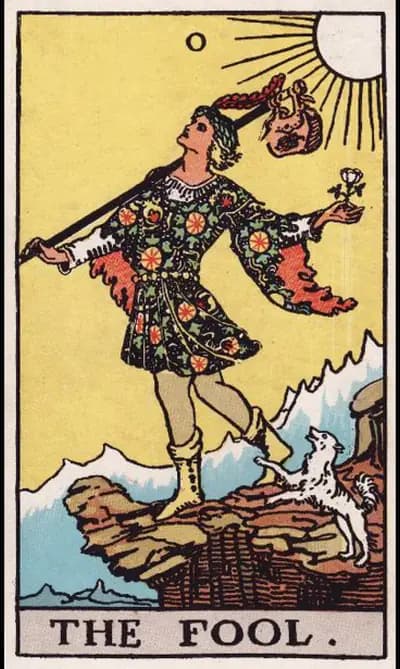
A young man in a flowered tunic steps toward a cliff edge, a white rose in his hand and a bundle on his shoulder; a small white dog leaps at his feet.
Pamela Colman Smith sets the Fool in full sun, against a yellow sky, at the edge of a cliff. He looks up, not at the drop ahead. The white sun in the corner lights the whole scene: nothing is hidden, and nothing has happened yet. His tunic is covered in wheels and flowers, and a red feather sits in his wreath of leaves. From his staff hangs an embroidered bag; Waite thought the older idea that it holds his follies and vices arbitrary. The white rose stands for a clean intention. The dog bounds at his heels, an instinct that warns him or plays along. Waite calls him a prince of another world passing through this one. Behind him rise snowy peaks.
The Fool upright
You are leaping without checking where your foot lands, and it looks a lot like folly. Sometimes it is; sometimes it's the only way to leave. Before you jump, check one thing: is this your drive, or a way of running off?
Upright, the Fool shows a beginning you cannot fully prepare for. A move abroad, a new trade, a relationship that starts fast, a sudden urge to change everything: the card describes the moment you move with more trust than information. Modern readers see innocence and spontaneity here. Waite saw folly and extravagance first.
Both readings hold. The same leap can be a release or an escape, which is why the meaning printed above asks you to check one thing before you go. If the pull comes from your own desire, it will carry you. If you are jumping so you no longer feel what you are leaving, that weight will be waiting when you land. The Fool passes no verdict. It asks the question at the cliff edge.
The Fool reversed
Either you leap without looking where you'll land, or you freeze at the edge waiting for a certainty that won't come. Both cost you. One small, real step is worth more than a grand imagined jump.
Reversed, the Fool keeps its urge to leave, but the urge jams or runs away with you. On one side, you jump without looking: quitting on impulse, a purchase that isn’t you, a yes given too fast. On the other, you stay at the edge, waiting for a guarantee nobody can give. Both often grow from the same fear. Waite, in 1910, read the reversed card as carelessness and apathy. The way through is plain: one small, real step, then another.
In love
In love, the Fool speaks of a bond that starts without a plan: someone met while travelling, a story born from chance, a wish for lightness. If you are already together, it asks for air and novelty, an outing you have never tried. It promises nothing about how long. It says this connection lives on spontaneity, and that one day you will both need to look where you are stepping.
Work and money
At work, the Fool goes with a change of career, a first job, a project started before you know everything. It favours learning and nerve more than management. With money, it asks for practical caution: keep savings before leaving a steady income, and test your idea on a small scale first. The impulse is precious. It goes further with a net under it.
As advice
As advice, the Fool says: go, but know why. Write down in one sentence what you are heading towards. If that sentence only names what you are escaping, wait a little longer. If it names what you want, take the first step this week.
Astrology and tradition
In the Golden Dawn system, the Fool has no planet and no sign: it belongs to the element of Air. Air is breath, what moves freely and refuses to be boxed in. It is also the first stirring, before anything takes shape. The Fool carries the Hebrew letter Aleph, the first of the alphabet. Some modern decks give it Uranus, but that is not the Golden Dawn tradition we follow here.