What the card shows
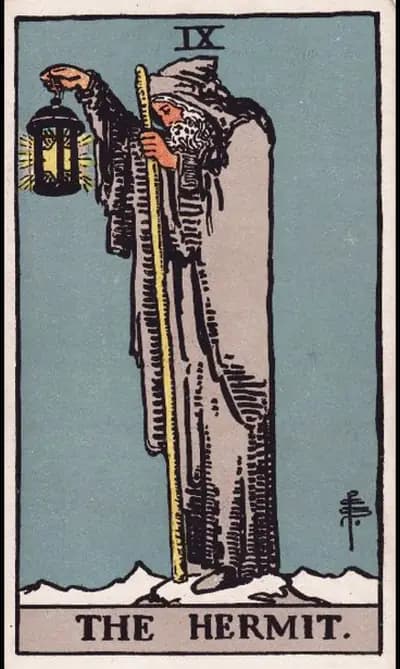
An old bearded man in a grey hooded cloak stands on a snowy peak, raising a lantern with a star inside; his other hand holds a tall yellow staff.
The Hermit stands alone on a snowy peak under a grey sky. So he has climbed: the snow speaks of a height reached, far from the valley. He wears a long grey hooded cloak, the colour of discretion. In his right hand, a lantern holds a star, as Waite says, which many readers see as six-pointed, like the seal of Solomon. In his left, a yellow staff, the support of someone who walks a long way. He does not look ahead but down, towards those who are climbing. Waite says his light signals that where he is, you may also come. The Hermit is no longer searching. He lights the way.
The Hermit upright
You need less noise, not more advice. Take an evening, a walk alone, a notebook: what you keep looking for outside becomes clearer once you turn down the volume around you. Your answer moves at walking pace, no faster.
Upright, the Hermit tells you that you need less noise, not more advice. An important decision, a break-up to digest, a change of direction, a question about what you really want: you have already asked plenty of people for their opinion. Now the answer has to come from you.
In practice, this is the card of an evening without screens, a long walk alone, a notebook you write in without rereading, a weekend away from your routines. It is not an escape. It is a chosen step back that leaves you clearer when you return. Waite spoke of prudence. Our reading leans on the lantern: you already have a light, and it just needs time to shine.
The Hermit reversed
Retreat has become a wall. You've stepped so far back you no longer hear anything, not even yourself. Or you avoid silence, afraid of what it might say. One honest conversation is enough to open the door again.
Reversed, the Hermit’s retreat becomes a wall. You keep so far apart that you no longer hear anything, not even yourself: you turn down invitations, leave messages unanswered, and the silence grows heavy day by day. Or it runs the other way: you fill every minute so you never have to be alone with your thoughts. Waite, in 1910, read concealment and needless caution here. A single honest conversation, with someone you trust, is often enough to open the door again.
In love
In love, the Hermit speaks of a need for space. In a relationship, it can describe a time when one of you needs to step back, which is not necessarily a rejection. If you are single, it invites you to know yourself better before looking for someone. It also favours calm, deep bonds where you can be silent together.
Work and money
At work, the Hermit favours research, expertise, and tasks that need focus and time alone. It backs the person who goes deep into a subject rather than the one who spreads thin. With money, it advises restraint and reflection: wait before a big purchase, and ask yourself what you really need.
As advice
As advice, the Hermit asks you to set aside one hour alone this week. No phone, no music. Walk or write, and ask yourself one question: what do I already know that I don’t yet dare to say?
Astrology and tradition
The Golden Dawn gives the Hermit to Virgo. Virgo is a mutable earth sign ruled by Mercury: discernment, sorting, attention to detail, care for work done well. It is also the sign of harvest, when grain is separated from chaff. The Hermit does that sorting inside himself, apart from others, to keep what is essential. The card carries the Hebrew letter Yod, the smallest of the alphabet.