What the card shows
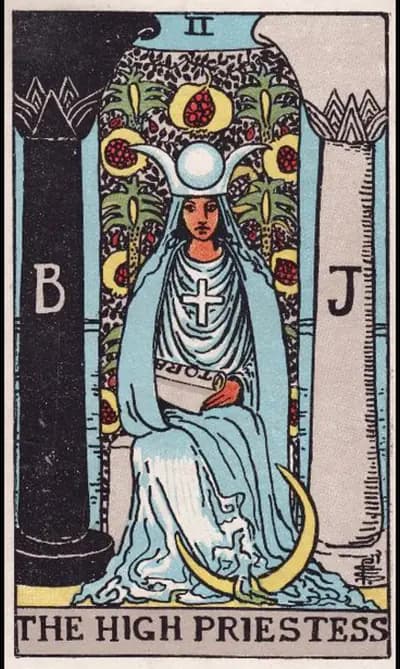
A woman in a blue cloak sits between a black pillar marked B and a white one marked J, holding a scroll; a crescent moon lies at her feet.
The High Priestess sits before the veil of a temple. The two pillars bear the letters B and J, for Boaz and Jachin, the columns of Solomon’s Temple. Black and white name opposites she holds together without choosing. Behind her, a veil embroidered with palms and pomegranates closes off the back of the temple. The pomegranate, a fruit full of seeds, carries mystery and hidden fertility in the tradition. On her lap lies a scroll marked TORA, partly covered by her mantle: Waite says some things are spoken and some only implied. Her horned crown holds a globe, a cross rests on her breast, and her blue robe flows down like water.
The High Priestess upright
You already know something you haven't said out loud yet. Before asking anyone else, give yourself a moment of quiet: the answer that returns when everything goes still is often the right one. Keep it to yourself while it ripens.
Upright, the High Priestess says the answer is already in you, just not in words yet. You sense that an offer hides something, that a friendship has shifted, that a project is the wrong one, without being able to prove it. The card asks you to take that knowing seriously. It does not push you to act fast. It pushes you to listen.
In practice, this is the card of quiet time: a night before you reply, a page you write only for yourself, a decision you don’t yet put to your friends for a vote. Waite tied the High Priestess to secrets and to a future not yet revealed. That is not a wall but a rhythm. Some things only make sense once you let them settle.
The High Priestess reversed
A passion drives you forward and you think you know more than you do. The ardour is real; the knowledge is still on the surface. Before you act, ask what your pride wants to prove, and what you have really understood.
Reversed, the High Priestess loses her calm. A passion drives you forward and you think you know more than you do. You have read three articles and feel you’ve mastered the subject; you have a hunch and take it for a certainty. Waite, in 1910, read passion, conceit and surface knowledge here, and our printed meaning follows him. It is intuition drowned out by noise: your ardour speaks so loudly that the quieter voice can’t get through. Slow down before you act, and separate what you feel from what you know.
In love
In love, the High Priestess speaks of what isn’t said yet. A quiet attraction, a bond where you understand each other without talking, or a doubt you keep to yourself. She doesn’t push for a declaration. She asks what you really feel when things are quiet, away from messages and advice. In a relationship, she guards a share of mystery, which every bond needs.
Work and money
At work, the High Priestess favours study, research, listening, and jobs where you observe before you speak. She advises discretion: don’t reveal a project too early, and keep sensitive information to yourself. With money, she asks you to check what you can’t see yet, such as the small print, before you sign anything at all.
As advice
As advice, the High Priestess asks for one hour of silence. No phone, no outside opinions. Write your question on a sheet of paper and note the first answer that comes back, even if it bothers you. Keep it for a few days before you talk about it.
Astrology and tradition
The Golden Dawn gives the High Priestess to the Moon. The Moon makes no light of its own; it reflects the Sun’s. This is knowledge that arrives by reflection, not by effort. The Moon governs tides, cycles, memory and whatever rises from the unconscious. The crescent at the Priestess’s feet and her lunar crown make the link plain to see. The card carries the Hebrew letter Gimel.