What the card shows
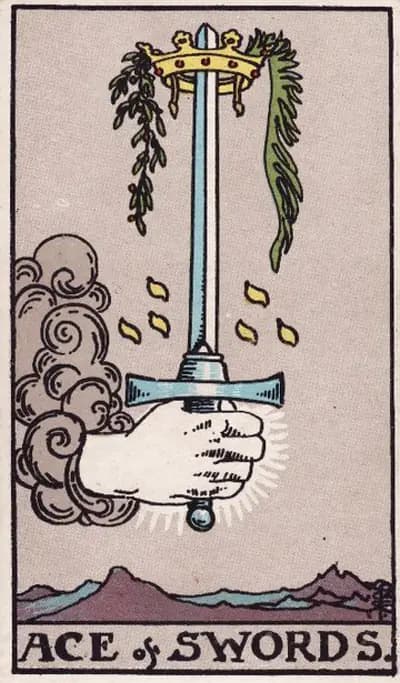
A white hand reaches out of a grey cloud gripping an upright sword; at its tip, a gold crown hung with an olive branch and a palm, above purple mountains.
As on every Ace in the 1909 deck, a hand reaches out of a cloud: a gift that comes from outside you, not something you built. The fist grips the hilt firmly, ringed by a faint glow. The sword stands upright and is double-edged, which the tradition reads as thought that cuts both ways. The gold crown at its tip is the victory of a clear mind. An olive branch hangs on the left for peace, a palm on the right for victory. Six golden drops fall around the blade. They are often read as yods, the Hebrew letter, and as grace coming down. Below lie bare mountains: a high view, and a cold one.
Ace of Swords upright
An idea finally comes into focus. You know what is true for you, even if it is uncomfortable to say. Name it plainly, out loud or on paper, then act on it: clarity dulls if you keep it in your head too long.
Upright, the Ace of Swords is a breakthrough in clarity. You have circled a problem for weeks and suddenly you see it. You understand why a relationship drains you, what you actually want from this job, or which sentence you need to say to your sister. Waite reads it as triumph, force carried to its highest degree.
That clarity asks for an act. A sharp idea dulls if it stays in your head too long. Write it down, say it, send the email you have been putting off. The Ace is also a beginning in the world of ideas: a writing project, a course, a decision of principle. The truth it brings is not always comfortable. It is simply accurate, and that is what lets you move.
Ace of Swords reversed
Your thoughts circle without deciding, or you are holding the truth like a weapon. Before you speak, ask yourself whether you want to clarify or to wound. Sometimes the fog has to settle first.
Reversed, the Ace keeps its force, but the force cannot get out, or it comes out crooked. Your thoughts loop without landing: you replay the same conversation ten times, you write lists of pros and cons that settle nothing. Or you hold an accurate truth like a weapon, to win rather than to clarify. The card then asks for a pause. Let the fog settle before you decide, and ask what your honesty is trying to get. Waite, in 1910, also cited another account that reads conception and childbirth here. We do not read pregnancy in the cards.
In love
In love, the Ace of Swords brings an honest conversation. This is the time to say what you really feel, or to ask plainly where the two of you stand, instead of decoding silences. If you are single, it can point to a meeting that starts with a real exchange of ideas. The card prefers clarity to softness: choose words that are true without being sharp.
Work and money
At work, the card favours anything that needs a clear head: a messy file to untangle, a plan to write, an argument to make in a meeting. It can mark a new idea that changes how you work. With money, it says to look at the actual numbers instead of guessing them. It promises no gain. It helps you decide with the facts in front of you.
As advice
The Ace of Swords as advice: name what is true, plainly, then act on it. Take a sheet of paper, write the sentence you have been avoiding, and decide who needs to hear it. Clarity only helps once it becomes an act.
Astrology and tradition
In the Golden Dawn system, the Ace of Swords carries the Book T title Root of the Powers of Air. Aces have no decan. They turn around the pole, above the zodiac, as the source of their element before it is shared out among the signs. Air is the element of Gemini, Libra and Aquarius: thought, exchange and speech. The Ace is its purest form, not yet pointed anywhere.