What the card shows
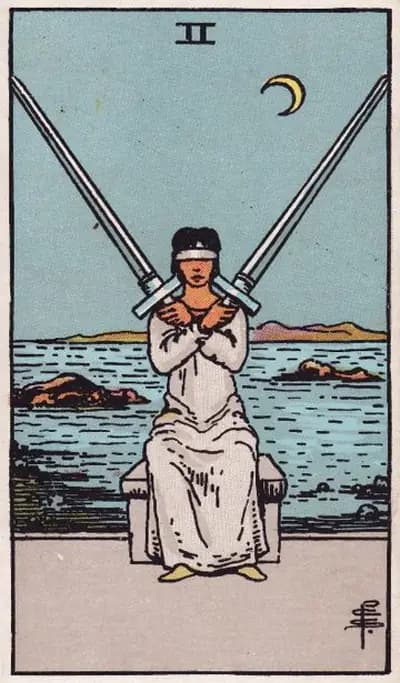
A blindfolded woman in white sits on a stone bench, two long swords crossed over her chest; behind her, a sea with rocks and a crescent moon.
A woman in a white robe sits on a stone bench with her back to the sea. She is blindfolded: she does not judge by what she sees, she listens to what happens inside. Her arms are crossed over her chest and hold two long swords, so heavy that one movement would break the balance. The tradition reads this as protecting the heart as much as blocking it. Behind her the water is calm, but rocks break the surface: feelings are there, just below. A crescent moon hangs top right, a reminder of the card’s decan, the Moon in Libra. The ground is flat and bare, with no path marked.
Two of Swords upright
Two forces hold each other in balance in you, and that takes courage; it isn't running away. A friendship, some tenderness, helps you keep this fragile peace. Keep it without rushing to decide: it gives you time to see what matters.
Upright, the Two of Swords describes a truce. Two options, two people or two loyalties hold each other in balance, and you choose not to cut yet. Waite sees courage, friendship and concord in a state of arms here: peace between two forces that stay ready. Some tenderness or a friendship often helps you hold that line.
Think of someone weighing two job offers, or staying neutral between two friends who have fallen out. The pause makes sense if it gives you time to see. It becomes a stalemate when you keep the blindfold on so you don’t have to look at what you already know. The question to ask: am I waiting for information, or avoiding a decision?
Two of Swords reversed
The balance was a front: someone is lying, or passing themselves off as what they aren't. This false peace won't hold. Listen for what rings false, including in what you tell yourself, and take your trust back where it was betrayed.
Reversed, the Two of Swords shows a balance that never really was one. The peace rested on a lie, an omission or a role: someone is passing themselves off as what they aren’t, or you are telling yourself that everything is fine. Waite, in 1910, read imposture and disloyalty here, and our reading follows him. The blindfold starts to slip. What you find may hurt, but it makes a decision possible. Take your trust back where it was betrayed, without blaming yourself for not seeing it sooner.
In love
In love, the Two of Swords often shows a relationship on pause, or a heart guarding itself. You are torn between two people, or between staying and leaving, and you would rather say nothing than break something. If you are single, the card can point to a heart closed out of caution after a disappointment. The peace holds for a while. An honest conversation, even a short one, beats a silence that drags on.
Work and money
At work, the card describes a decision put off: two offers, two methods, two colleagues who each want your support. Staying neutral can be wise for a few days. After that, indecision costs more than the wrong choice. With money, the Two of Swords asks you to set both options down on paper, with figures, before you sign anything.
As advice
The Two of Swords as advice: give yourself a date. Keep the truce if it helps you see, but decide the day you will take the blindfold off. Until then, gather the information you are missing instead of turning over what you already have.
Astrology and tradition
Book T calls this card the Lord of Peace Restored. Its decan is the Moon in the first ten degrees of Libra. Libra seeks agreement and balance; the Moon, changeable and sensitive, makes that balance gentle but unsteady. Two is the number of initiation, a thing just started. Here it is a peace newly born after conflict, and still fragile.