What the card shows
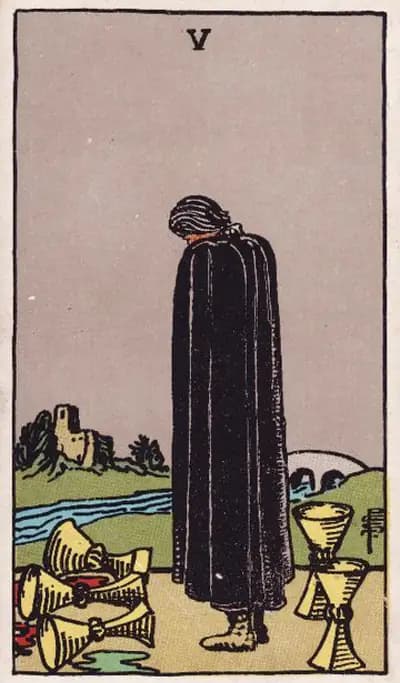
A figure in a long black cloak, head bowed, stares at three spilled cups; behind them stand two upright cups, a river and a bridge.
A figure wrapped in a long black cloak stands with head bowed. Black is the colour of mourning: the whole body is turned toward what is lost. In front lie three cups on their sides. What was in them has run out, red and green. Waite writes that a loss has happened, but something remains. That remainder is right there behind the figure: two cups standing, untouched, unseen. A river separates the scene from a small keep on the far bank. A bridge crosses it. The tradition reads the way back: you can reach the far bank, but first you have to turn around.
Five of Cups upright
Something has spilled and you are allowed to be sad about it. But look behind you too: what still holds is there, untouched. Grieve what is lost, then turn gently toward what remains.
Upright, the Five of Cups is a sorrow that fills the whole room. A breakup, a friendship fading, a project that failed, a family disappointment. You replay the scene and look for what you should have done differently. Waite gives loss with something left over, and speaks of an inheritance that falls short of expectations, or, for some interpreters, a marriage not without bitterness.
The card does not ask you to feel better straight away. It admits that something really has spilled. It only reminds you that not everything is on the ground. A friend who stays, a skill you gained, a part of you the loss did not touch. Grief needs time, and what remains will wait for you to turn around.
Five of Cups reversed
You are starting to lift your head: accepting, forgiving, turning toward what is left. Just be careful not to turn the page too fast, before you have truly let the loss move through you.
Reversed, the Five of Cups shows the moment you lift your head. You accept what happened. You forgive, the other person or yourself. You finally notice the two standing cups. Waite, in 1910, read the reversed card as news, alliances, someone's return. In our reading there is one caution: don't turn the page too fast. A grief you step over tends to come back later. Healing is rarely a straight line. Let the loss move through you, then walk toward the bridge.
In love
In love, the Five of Cups speaks of regret. A breakup that still hurts, an argument that left a bitter taste, a story that did not give what you hoped for. In a couple, it may show that one of you is chewing over a disappointment. The card does not say it is over. It asks you to name what was lost, and to look at what still holds between you.
Work and money
At work, the Five of Cups comes with a setback or a disappointment: a rejected project, a promotion that doesn't come, a collaboration gone wrong. Before you question everything, list what remains: your skills, your contacts, what you learned. With money, the card asks you to take stock of a loss calmly, without judging yourself for it.
As advice
As advice, the Five of Cups tells you to grieve what needs grieving. Don't rush. Then, one day, turn around. Write down two things that still hold in your life. They do not replace what you lost. They help you find your way home.
Astrology and tradition
The Five of Cups corresponds to Mars in Scorpio, the first decan of Scorpio. Mars, the planet of cutting and conflict, rules Scorpio in traditional astrology. In this sign of deep water its force cuts into feeling: something breaks, and the wound goes deep. Book T calls the card the Lord of Loss in Pleasure. The number five marks opposition and obstacle: the rest of the spread shows how it resolves.