What the card shows
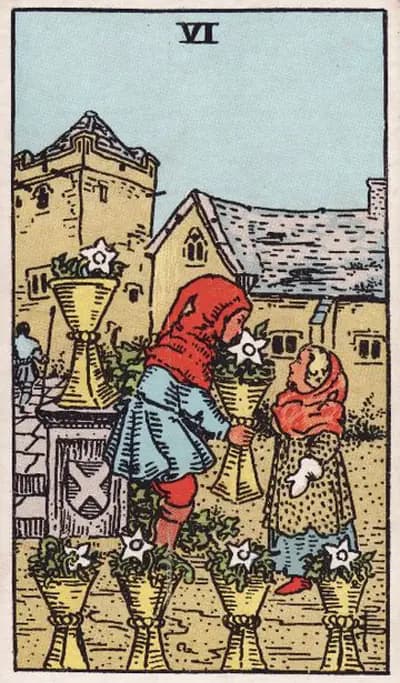
In a village courtyard, a child in a red hood hands a cup of white flowers to a little girl; six flower-filled cups stand around them.
Waite describes children in an old garden, their cups filled with flowers. The taller one, in a red hood, leans down to hand a cup to a smaller girl. The gesture is protective, almost parental. The flowers are white and star-shaped. There are six cups in all, every one of them in bloom, set around the children. The setting is old: stone walls, a house, a tower. On a pedestal, a shield bears an X-shaped cross. In the background a guard walks away with his spear. Many readers see adulthood leaving and letting the children play. Everything here is sheltered, as in a memory.
Six of Cups upright
A sweet memory resurfaces, someone from before gets back in touch, a small gesture moves you more than expected. Welcome it without looking further: giving or receiving a little uncalculated tenderness does you good today.
Upright, the Six of Cups is the past returning gently. A smell that takes you back to your grandparents' house, an old photo, a message from a childhood friend. Waite makes it a card of the past and of memories: happiness that comes from what has been rather than from what is.
The card also speaks of kindness without calculation. Buying someone a coffee, lending a book, listening to someone who needs it. The older child gives without expecting anything back. That is the gesture the card offers you today, in one direction or the other. It can also describe someone from your past coming back. Like every Six, it marks a clear accomplishment: something good is already here, you only have to see it.
Six of Cups reversed
You are finally turning toward the future. The past has finished speaking, and something is renewing itself: a project, a bond, a wish. Leave memories where they are and ask what you want next.
Reversed, the Six of Cups turns toward the future. Waite read the reversed card that way: the future, renewal, what will come to pass soon. Our reading follows him. The past has finished speaking. You put memories back where they belong and something renews itself: a project, a bond, a fresh wish. The only question is simple: what do you want now? If you still catch yourself idealising a time in your life, remember it was not as perfect as your memory makes it.
In love
In love, the Six of Cups speaks of tenderness and familiarity. A relationship that feels like a shelter, a playful, almost childlike closeness, small gestures that matter. It can also point to someone from your past coming back, or an old story resurfacing. The card does not say whether that is a good idea. It asks you one thing: do you love the person, or the memory?
Work and money
At work, the Six of Cups speaks of goodwill and of passing things on. A former colleague who recommends you, a mentor who helps, a field linked to childhood, education or heritage. It can also mark a return to a project you had set aside. With money, the card favours small generous exchanges, and warns against purchases made out of nostalgia.
As advice
As advice, the Six of Cups invites a simple gesture. Message someone you have lost touch with. Give something for no reason. Find a childhood pleasure again: drawing, walking, cooking a family dish. The sweetness of the past can feed your present without holding you back in it.
Astrology and tradition
The Six of Cups corresponds to the Sun in Scorpio, the second decan of Scorpio. Scorpio is a sign of deep water, the sign of memory and of what is buried. The Sun brings its light there: it lights up what was sleeping and makes it warm. Book T calls the card the Lord of Pleasure. The number six marks a definite accomplishment: the pleasure is real and already present.