What the card shows
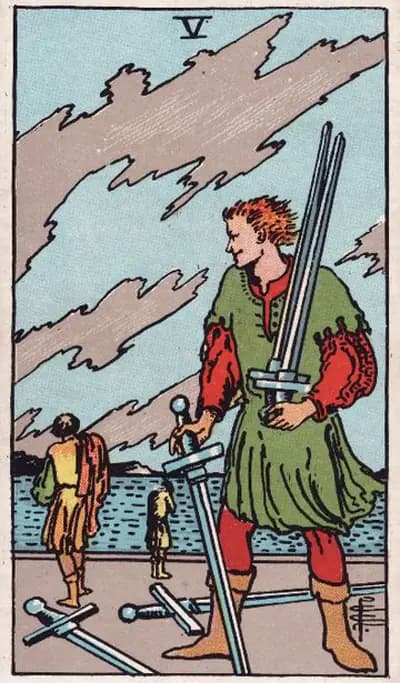
A red-haired man in a green tunic holds three swords and smiles; two more lie on the ground as two figures walk off toward the sea under torn clouds.
In the foreground, a red-haired man holds three swords and looks back with a small smile. Waite describes him as the master in possession of the field. Two more swords lie on the ground, abandoned. Further off, two figures walk away toward the sea with their backs turned; one seems to hide their face in their hands. The sky is torn by thin, wind-driven clouds: the tension still hangs in the air. He wears a green tunic over red sleeves. The winner gathers the weapons, but he is left alone on the shore. The whole card shows the gap: victory on one side, loss on the other, and nobody to celebrate with.
Five of Swords upright
You got the last word, but the people around you are drifting away. Before reopening the argument, ask what being right actually earns you. Sometimes picking up the swords costs more than leaving them on the ground.
Upright, the Five of Swords shows a victory that costs too much. You got the last word in a family argument, pushed your idea through in a meeting, proved you were right. But the mood around you has cooled. Waite reads degradation, loss and dishonour here, for those who leave as much as for the one who stays.
The card can put you in either role. Sometimes you are the one who won and has to ask at what price. Sometimes you are the one walking away, hurt, and right to leave. Either way, it invites you to look at what the conflict is protecting: pride, fear, an old grudge. Picking up every sword is not always a victory.
Five of Swords reversed
The defeat weighs heavier still, and there is something to mourn: a bond, an image of yourself, a place you held. You don't have to do it alone or quickly. Let yourself be sad before you try to get up.
Reversed, the Five of Swords makes the defeat heavier. What you lost in the conflict weighs more than you expected, and there is something to mourn: a bond, an image of yourself, a place you held. Waite, in 1910, kept the same sense in a darker shade, adding burial and mourning. We read it as symbolic grief, never as a sign of a death. You don’t have to get up quickly. Let yourself be sad before you go looking for who was right.
In love
In love, the Five of Swords shows an argument where each person wants to win. Words become weapons, old grievances come back out, and the goal becomes the last word rather than understanding. The card asks whether this battle is worth what it damages. If you are single, it can point to a past relationship that ended badly and still leaves some bitterness.
Work and money
At work, the card describes rivalry, hard competition or a power struggle. You can win the account and lose your team’s trust. It can also warn about someone who is not playing fair. With money, it advises against costly fights over a point of principle. Work out what the victory would really bring you.
As advice
The Five of Swords as advice: choose your battles. Before you reopen an argument, ask what you want from it: peace, fairness, or only the last word. Sometimes leaving the swords on the ground is the strongest decision you can make.
Astrology and tradition
Book T calls this card the Lord of Defeat. Its decan is Venus in the first third of Aquarius. Venus seeks harmony and affection; Aquarius, the fixed Air sign, is cool and detached. In that climate, Venus’s gentleness is not enough to calm the conflict. Five is the number of opposition and obstacle: the fight is here, and how it ends shows in the neighbouring cards.