What the card shows
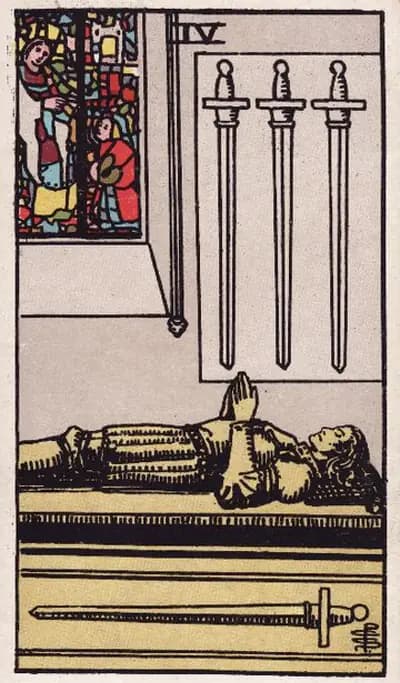
A knight's effigy lies on a golden tomb, hands joined in prayer; three swords hang on the wall above, a fourth is carved along the side, beside a stained-glass window.
A knight lies on a tomb, hands joined in prayer. The tradition says he is not dead but an effigy: the image of complete, almost sacred rest. His eyes are closed and his armour is still on. Three swords hang on the wall, points down, like thoughts suspended and left alone for now. The fourth lies along the side of the tomb, within reach: the fight is not forgotten, only set aside. In the top left, a stained-glass window shows a standing figure reaching a hand toward a smaller one who seems to kneel. The setting is a church: a protected, silent space.
Four of Swords upright
You don't have to fix everything this week. Rest is the task now: sleep, mute the notifications, let decisions wait a little. What you recover now is the clarity you'll need next.
Upright, the Four of Swords asks for rest in the most concrete sense. You are coming out of a stretch of effort, conflict or worry, and your mind needs quiet before what comes next. Waite reads vigilance, retreat, solitude and the hermit’s repose here.
Think of someone just out of an exam, a house move, a breakup or a draining project. The card tells them: you don’t have to fix everything this week. Sleep more than usual, mute the notifications, postpone the decisions that can wait. A retreat can also be a real place: a day alone, a long walk, a few days away from home. What you recover now is the clarity you will need to start again.
Four of Swords reversed
You are taking things back in hand with care: counting, managing, saving your strength. That is wise, until it turns into meanness. Keep the measure, but don't refuse yourself what would do you good.
Reversed, the Four of Swords shows the return after rest. You put things back in order slowly and with care: you count, you manage your strength, you choose where your energy goes. Waite, in 1910, read wise administration, precaution and economy here, but also avarice. That is where the card warns you. Caution turns into excessive restraint when you refuse yourself everything, rest and pleasure alike, out of fear of running short. Keep the measure, but don’t lock yourself inside it.
In love
In love, the Four of Swords describes a pause. After an argument or a tense stretch, each person needs a little space and quiet before talking again. That distance is not necessarily a worrying one. If you are single, the card can show a chosen time of retreat, to find yourself again before opening up to someone. Respect that rhythm, yours and theirs.
Work and money
At work, the card advises easing off. Take the holiday you keep postponing, slow down before you burn out, or give yourself a day without meetings to think. A project may also be on hold, waiting for approval. With money, the Four of Swords is not the moment for big decisions. Let things rest, reread them with a cool head, then decide.
As advice
The Four of Swords as advice: rest before you absolutely need to. Block out time in your calendar where nothing is asked of you. Rest is not a reward after effort. It is part of the work, the part that makes the rest possible.
Astrology and tradition
Book T calls this card the Lord of Rest from Strife. Its decan is Jupiter in the last third of Libra. Jupiter, the planet of goodwill and breadth, softens the Swords and offers a respite. Libra loves peace and harmony. Four is the number of completion: a matter settled and fixed. Here it is calm that settles in and holds.