What the card shows
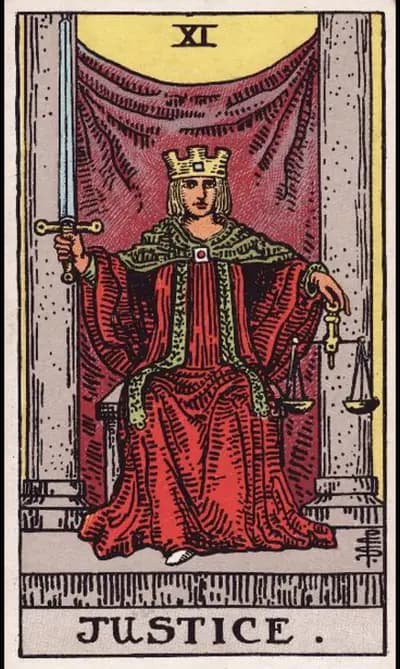
A crowned figure in a red robe sits between two grey pillars, raising an upright sword in one hand and holding a pair of scales in the other.
Pamela Colman Smith seats her Justice facing you, still, eyes level with yours. The sword points straight up: it is double-edged and leans neither way. The scales in the other hand hang even. Behind her, a purple-red veil is stretched between two grey pillars, much like the High Priestess's, but here the veil hides no mystery; it marks out a court. Her crown carries a small square, and another closes her green cape at the breast. Under the red robe one white shoe shows, a reminder, for many readers, that every act has consequences. The yellow behind the veil is a light that shows things as they are.
Justice upright
It's time to look at the facts as they are, without softening them. Weigh what you owe and what you're owed, then decide. A fair choice isn't always comfortable, but it lets you stay at peace with yourself.
Upright, Justice speaks of a time to look at the facts without tidying them up. You may have a contract to reread, an argument where both sides share the blame, a promise to keep or to hand back. The card does not tell you who is right. It asks you to put everything on the scale: what you gave, what you received, what you said and what you left unsaid.
It also speaks of consequences. What you set in motion comes back, for good or ill, and that is not punishment, only the logical next step. Waite read it as equity, rightness, probity and the deserving side winning in law. We read no verdicts here, but the card does ask you to act in a way you could defend to yourself a year from now.
Justice reversed
Something rings false: an unfair situation you keep tolerating, or an endless trial you hold against yourself. You don't have to judge yourself more harshly than you would a friend.
Reversed, Justice keeps its scales, but they tilt. Sometimes outward: you put up with something unfair, a lopsided share of the chores, a rule applied to some people and not others, and you stay quiet to avoid a fight. Sometimes inward: you keep a trial running against yourself over an old mistake, playing both prosecutor and judge.
Either way the balance is stuck. The way out is the same: swap impressions for facts. Write down what actually happened, then ask how harsh you would be with someone you love. Waite, in 1910, read the reversal as legal complications and excessive severity.
In love
In love, Justice asks for a balanced bond. Who texts first, who adapts, who always apologises? If the scale has been tipped for a long time, the card suggests saying so calmly, with concrete examples rather than accusations. With someone new, it speaks of clarity: knowing what you want and saying it early. It promises neither a return nor a break-up. It asks for the truth.
Work and money
At work, Justice touches contracts, reviews and accounts. It is a good time to read the small print, ask for a raise with numbers to back it, correct an invoice or point out a mistake, your own included. With money, it says keep what is yours clearly separate from what is not. For a legal or tax question, it sends you to a professional, not to the cards.
As advice
As advice, Justice says: write the facts down in two columns, without adjectives. Decide from that page, not from your anger or your guilt. Then stand by your choice and what follows from it, simply, without explaining yourself ten times over.
Astrology and tradition
The Golden Dawn gives Justice to Libra, and the link is easy to see: the scales are the sign's own symbol. Libra is an air sign, the sign of judgement and relationship, ruled by Venus, which looks for agreement. Saturn is exalted there, and the tradition reads that as rule, law and measure. The Sun enters Libra at the autumn equinox, when day and night are equal: the exact balance on the card.