What the card shows
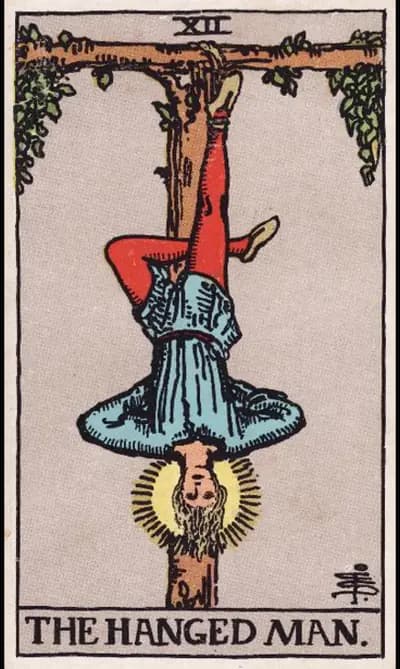
A man hangs upside down by one foot from a leafy wooden beam; blue tunic, red tights, a golden halo around his calm face.
Pamela Colman Smith's Hanged Man is not being tortured. He hangs by one foot from a T-shaped beam of living wood, still sprouting leaves. Waite is clear about this: it is life in suspension, not death. His free leg is bent behind the other to make a cross, and his arms, hidden behind his back, form a triangle. His face is calm, almost entranced, and a golden halo surrounds it. The tradition reads this as insight that comes precisely from the awkward position. The blue tunic and red tights put mind and body together, both turned over at once.
The Hanged Man upright
Something is on hold and you can't force it. Let yourself stop for a while: seen upside down, the situation shows you what you were missing. This waiting time isn't wasted; it gives you a new way to read things.
Upright, the Hanged Man describes a stretch when nothing moves, whatever you do. A file is waiting for an answer, a relationship is in limbo, a project depends on someone else. The card suggests you stop pushing. The time is not wasted: looking at the situation upside down, you notice what all the rushing was hiding.
It also speaks of sacrifice in a plain sense: giving up one thing to gain another. Skipping a night out to finish a piece of work, letting the other person be right to keep the peace, taking leave to think. Waite read the card as wisdom, discernment, trial and sacrifice. The card asks that the giving up be chosen, not endured in silence.
The Hanged Man reversed
You follow what everyone is doing, or you think only of yourself: two ways of not really giving. Ask what you refuse to offer, and to whom. Step out of the crowd for an hour to hear it.
Reversed, the Hanged Man shows two ways of not really giving yourself. The first is following the crowd: doing what everyone does so you never have to choose, repeating the group's opinion. The second is turning inward and refusing any effort that does not pay off at once. Either way, the card's useful pause gets stuck.
Waite, in 1910, read it as selfishness and the crowd, and that is the reading we keep. The question to ask is what you refuse to offer, and to whom. An hour alone, away from other people's views, is often enough to hear the answer.
In love
In love, the Hanged Man describes a story on hold. A message left unanswered, a relationship that will not define itself, a couple going through a flat patch. The card says neither give up nor force it. It asks you to see the bond differently: what you give, what you expect back, and what you could let go of. Sometimes the waiting is already an answer.
Work and money
At work, the Hanged Man often points to a stalled project or a decision someone else keeps postponing. Rather than chasing it again, use the time: look at the file from a new angle, learn what you were missing, prepare the next step. With money, it advises committing nothing while things stay unclear. A purchase put off for a month rarely costs much.
As advice
As advice, the Hanged Man says: stop pushing a door that will not open today. Take a sheet of paper and describe the situation from the other person's side, or from where you will be in five years. That change of angle is the real work right now.
Astrology and tradition
The Golden Dawn gives the Hanged Man no planet. It gives it the element of Water, just as it gives Air to the Fool and Fire to Judgement. Its Hebrew letter is Mem, water. Water does not resist: it takes the shape of whatever holds it and reflects the world upside down, the way a lake turns the trees over. That is the Hanged Man's posture: yield, reflect, and wait for clarity to settle.