What the card shows
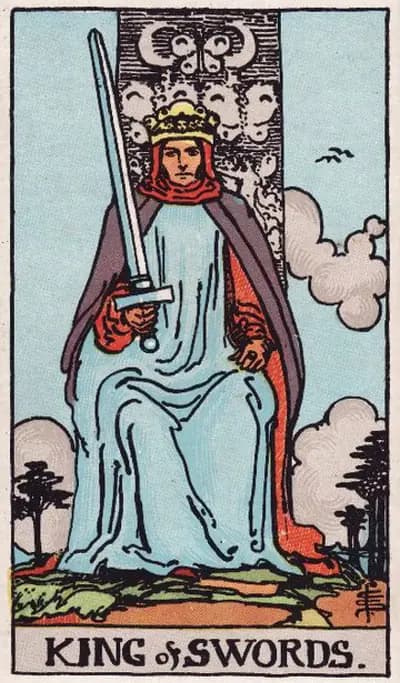
A king in a blue robe and a purple cape lined with red sits facing you on a throne carved with butterflies, holding an upright sword; clouds and two birds drift behind him.
The King sits facing us, upright, looking at whoever consults him. He holds his sword unsheathed and raised, tilted slightly. Waite writes that he sits in judgment and recalls the figure of Justice among the major arcana. He wears a blue robe under a purple cape lined with red, and a gold crown. The tall back of his throne is carved with butterflies and crescent moons, signs of Air and of thought. Behind him stand a few trees, some clouds and two birds. The sky is clear, with no storm: the King’s mind is settled. He sits on a grassy rise, reason grounded in the real.
King of Swords upright
This is the time to decide with a clear head. Lay out the facts, hear every side, then choose and keep your word. Being fair doesn't mean being harsh: your clarity also protects the people who rely on you.
Upright, the King of Swords describes a moment that calls for a decision made with a clear head. Lay out the facts, hear every side, then decide and keep your word. Waite reads judgment, power, command, authority and law here. It is the card of whoever has to arbitrate: a family decision, a team conflict, a life choice that needs rigour.
Being fair does not mean being harsh. Your clarity also protects the people who rely on you, because a clear rule reassures more than a mood does. As a person, the King can be someone reliable and demanding: an adviser, a mentor, an expert whose opinion counts. He can also ask you to take that place yourself.
King of Swords reversed
Clarity is turning cold. You may be right, but you wound while being right, or someone is using logic to make you doubt yourself. Look at who holds the sword, and what for.
Reversed, the King of Swords shows clarity turning cold. You may be right, but you wound while being right. Or someone uses logic and authority to make you doubt yourself: they twist your words, they have an answer for everything, and you leave each exchange more confused. Waite, in 1910, read cruelty, perfidy and evil intention here. The card asks you to look at who holds the sword, and what for. You are allowed not to be convinced, and to take your time.
In love
In love, the King of Swords asks for a relationship built on honesty and on keeping commitments. It favours adult conversations, where things are said and promises kept. It can also describe someone more at ease with ideas than with feelings. If you are single, the card invites you to know clearly what you are looking for, and not to compromise on what matters most.
Work and money
At work, the card favours considered decisions, expertise and responsibility: leading a team, settling a disagreement, writing a clear rule. It suits work in law, consulting, analysis and teaching. It advises deciding on facts, not impressions. With money, it suggests consulting a qualified person before any major commitment, and reading every line yourself.
As advice
The King of Swords as advice: decide with a clear head, then keep your word. Hear every version, write down the facts, choose. And when you cut, remember the people involved: justice without consideration turns into harshness.
Astrology and tradition
In the Golden Dawn, the King of Swords corresponds to Book T’s figure in a chariot, here the Prince of the Chariot of the Winds. He is Air of Air: the element in its purest and most controlled form. That gives intelligence, analysis and impartiality, and also a certain distance. Book T assigns him the stretch from late Capricorn to late Aquarius.