What the card shows
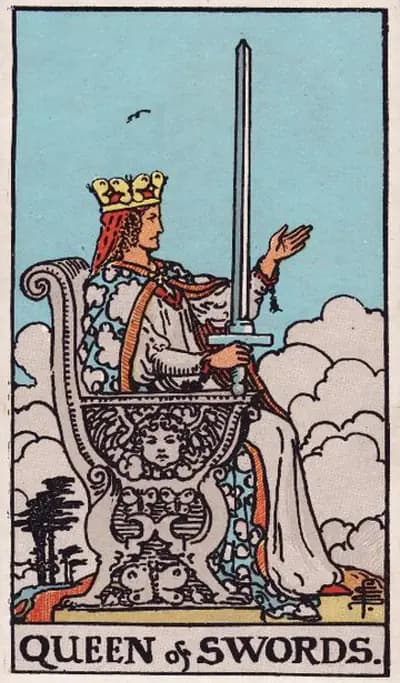
A crowned queen in profile sits on a stone throne carved with a winged face, holding an upright sword and raising her other open hand; one bird in the blue sky.
A crowned queen sits in profile on a stone throne, facing right. Her right hand holds the sword straight up; her left hand opens and lifts, as if to welcome, or to say: enough. Waite describes her face as severe but chastened, suggesting familiarity with sorrow. A tassel hangs from her wrist. Her crown and throne are decorated with butterflies, symbols of Air and of the soul, and a winged child’s head is carved below the armrest. Clouds gather at her feet, but the sky above her is clear blue. A single bird flies very high: the tradition reads a solitary, clear thought.
Queen of Swords upright
You know the sorrow of a separation, an absence, and it has made you clearer-eyed than you would have chosen. You don't have to hide it. Carry it upright, say what you miss, and let that clarity serve you without hardening you.
Upright, the Queen of Swords describes clarity born of experience. You have known a separation, an absence, a grief or a disappointment, and it has made you more clear-sighted than you would have chosen. Waite reads sadness, absence and separation in this card: the tradition makes her the queen who has lost something.
Our reading keeps that sorrow without turning it into a prediction. The card says you don’t have to hide it. Carry it upright, say what you miss, and let the clarity serve you: spotting flattery, setting a limit calmly, saying no without ten minutes of justification. As a person, the Queen can be someone frank and fair, whose honesty can intimidate but always helps.
Queen of Swords reversed
An old hurt is speaking for you, and your words cut deeper than they need to. Or you keep it all in and quietly harden. Before you answer, ask yourself what you're really trying to protect.
Reversed, the Queen of Swords shows an old hurt speaking for you. Your words cut deeper than they need to, you judge fast, irony takes the place of honesty. Or you keep it all in and quietly harden. Waite, in 1910, read malice, bigotry and deceit here, and our reading follows that idea of a blade held badly. The card asks what you are really trying to protect. Pain that is acknowledged, even quietly to yourself, makes your words fairer and kinder.
In love
In love, the Queen of Swords asks for clarity and respect. She has no patience for games or mixed messages: she wants to know where she stands. She can show someone who has been hurt and moves forward carefully. If you are single, the card describes a time of chosen independence. Say what you want and what you no longer want, and hold to it gently.
Work and money
At work, the card favours precision, analysis and honesty: rereading a contract, giving a frank opinion, bringing order to a vague situation. It suits roles that call for judgement and independence. It advises staying clear without becoming brittle. With money, it helps you see the figures without illusion and turn down what does not suit you.
As advice
The Queen of Swords as advice: tell the truth with precision and kindness. Set a clear limit where you need one, without apologising for existing. Your clarity is a gift as long as it serves what matters.
Astrology and tradition
In the Golden Dawn, the Queen carries the Book T title Queen of the Thrones of Air. She is Water of Air: the sensitivity of Water at the heart of thought. That gives a mind that feels, that picks up nuance, but cuts when it has to. Book T assigns her the stretch from late Virgo to late Libra, two signs of discernment and fairness.