What the card shows
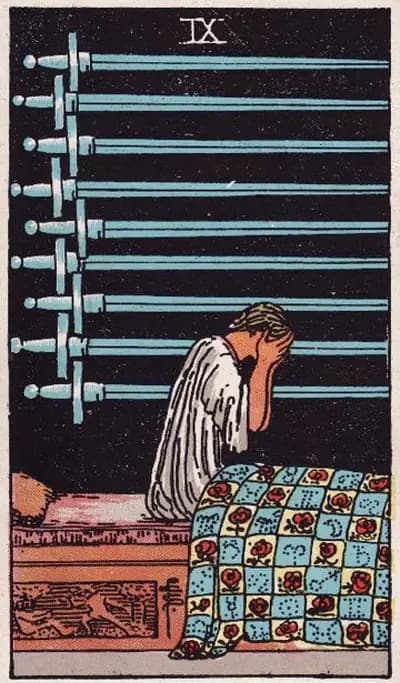
A figure sits up in bed with their face buried in their hands; nine horizontal swords against a black sky, a quilt patterned with red roses.
A figure sits up in bed in a white nightshirt, face hidden in their hands. The background is entirely black: it is night, and nothing exists but what they are thinking. Nine horizontal swords float behind them, like thoughts lined up and returning one after another. None of them touches the sleeper. The quilt is made of squares, with red roses and symbols the tradition reads as astrological signs. On the side of the bed is a carved panel where many readers see one figure fighting another: the struggle is happening inside, in the night. The pain is real, but the blades stay in the dark.
Nine of Swords upright
What worries you grows bigger at night, when you are alone with your thoughts. Write it down or tell someone tomorrow: in daylight, these fears shrink back to their real size, often much smaller.
Upright, the Nine of Swords describes the anxiety that wakes at night. At three in the morning, a comment at work becomes a disaster, an unanswered message becomes abandonment, an old mistake plays on a loop. Waite calls it a card of utter desolation. Our reading brings it back to what it shows: the suffering of thoughts.
The card does not say your worries are absurd. It says they grow when you are alone with them. Write them down as soon as you wake, or tell someone the next day. In daylight these fears often shrink back to their real size. If a worry comes back every night, it deserves to be shared properly, with someone close to you or with a professional.
Nine of Swords reversed
Doubt has you shut in: suspicion, shame, a fear that isn't absurd but has taken all the room. You have reasons to worry, not to condemn yourself. Say aloud what you fear, to someone safe.
Reversed, the Nine of Swords shows doubt that shuts you in: suspicion, shame, a fear that isn’t absurd but has taken all the room. Waite, in 1910, read suspicion, doubt, reasonable fear and shame here, and our reading keeps those words. You may have good reasons to worry. You have no reason to condemn yourself. The card invites you to say aloud what you fear, to someone safe. Shame that is spoken aloud, to the right person, loses much of its power.
In love
In love, the Nine of Swords speaks of worry: fear of being left, jealousy, guilt over something said or done. You replay scenes at night and imagine the worst. The card does not confirm your fears. It invites you to ask the question directly and calmly, rather than looking for the answer alone in the dark. If you are single, it can point to a fear of putting yourself out there again.
Work and money
At work, the card describes stress spilling into your sleep: a file that worries you, a mistake you fear you made, a meeting you dread. It advises writing down the concrete problems and keeping them apart from the imagined scenarios. Talk about what worries you with someone you trust. With money, do your accounts in daylight, not at midnight.
As advice
The Nine of Swords as advice: get your fears out of your head. Keep a notebook by the bed and write down what wakes you. The next day, read it again and tell someone. What you name grows smaller.
Astrology and tradition
Book T calls this card the Lord of Despair and Cruelty. Its decan is Mars in the middle third of Gemini. Mars is the force that attacks. In Gemini, the sign of thought and words, that force turns against the mind itself: thoughts become blows. Nine is the number of very great fundamental force, for good or ill. Here it is a thought pressing down with all its weight.