What the card shows
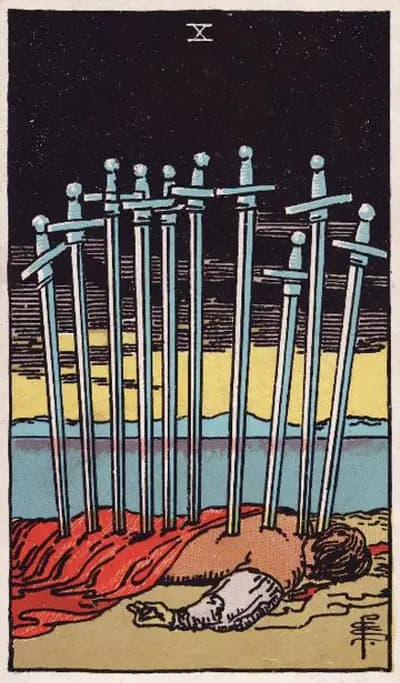
A man lies face down, a red cloth over his body and ten swords driven into his back; beneath the black sky, a yellow band of dawn lights the water.
A man lies face down, a red cloth over his body, ten swords driven into his back. The image is deliberately excessive: one blade would have been enough. The tradition reads the end of something, pushed all the way, with no way back. The sky is black, but a wide yellow band runs above the still water: dawn is coming. The mountains in the distance are blue and peaceful. Look at his right hand: some readers see in it the Hierophant’s gesture of blessing. Even on the ground, something in him is still alive. The water no longer moves. The storm has passed.
Ten of Swords upright
Something is truly over, and it hurts. But it is over: you no longer have to hope or fight for it. Let yourself admit you've hit bottom, rest, then look at the horizon: light is already returning behind what brought you down.
Upright, the Ten of Swords describes a real ending. A relationship is over, a project stops, a situation you were holding up at arm’s length collapses. Waite reads pain, affliction, tears and desolation, and he adds that it is not especially a card of violent death. The card speaks of what is ending, not of anyone’s life.
Its harshness hides a kind of relief. What is over is over: you no longer have to hope, negotiate or fight for it. People often breathe more easily on the day they accept that something has truly ended. The Ten invites you to admit you have hit bottom, to rest, then to look at the horizon. The light is coming back behind what brought you down.
Ten of Swords reversed
You are starting to get up, slowly. Or you stay lying there counting the blades, replaying the wound. Pulling the swords out one by one means accepting that it is done.
Reversed, the Ten of Swords shows the moment you start to get up, slowly. Or the moment you stay on the ground counting the blades, replaying the wound, still searching for what you could have done. Both are possible, sometimes on the same day. Pulling the swords out one by one means accepting that it is done. Waite, in 1910, read a gain or success that does not last here: a real recovery, but one to build on patiently, day by day.
In love
In love, the Ten of Swords speaks of an ending: a breakup, an illusion falling away, a relationship that cannot go on as before. It does not say who is to blame. It says something is truly over, and that clinging to it prolongs the pain. If you are single, it can show the moment an old story finally lets go of you. The dawn in the card is the room that opens up.
Work and money
At work, the card describes the end of a cycle: a dropped project, a job that ends, a failure you can no longer ignore. It advises drawing a clean line rather than holding on at any cost. Take stock, keep what you learned, rest before you set off again. With money, it asks you to stop a loss instead of dragging it out.
As advice
The Ten of Swords as advice: accept that it is over. You don’t need to understand why straight away. Rest, let the night pass, and pull the swords out one by one, at your own pace. The day is rising behind you.
Astrology and tradition
Book T calls this card the Lord of Ruin. Its decan is the Sun in the last third of Gemini. The Sun gives life and clarity. In Gemini, a double and mutable sign, its light scatters into a thousand thoughts and loses its centre. Ten is the number of fixed, complete force that has run its course, for good or ill. Here the ending is complete, and that is what makes a new start possible.