What the card shows
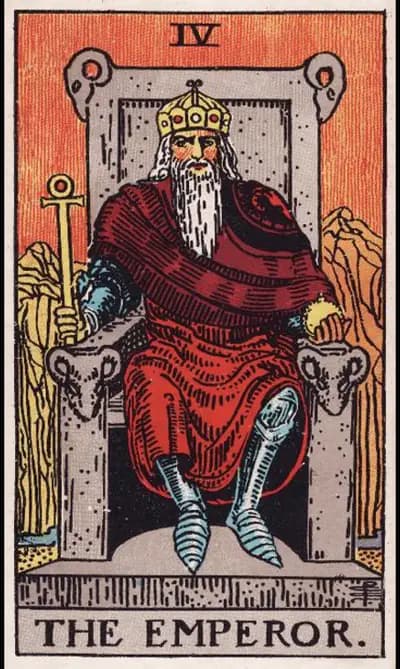
A white-bearded old man in a gold crown and red robe sits on a stone throne carved with ram heads, holding a sceptre; behind him, an orange sky and mountains.
The Emperor sits on a stone throne, square and massive. Four ram heads decorate it, two at the top of the back and two on the armrests: that is the sign of Aries, his correspondence. In his right hand he holds a sceptre shaped like an ankh, the Egyptian cross of life. In his left, an orb: he holds the world he rules. Under his red robe, armour shows: he is ready to defend what he has built. His white beard speaks of experience. Behind him rise bare mountains under an orange sky. At their foot runs a thin stream, which the tradition reads as a trace of feeling in that hard landscape. Waite calls him the power of this world.
The Emperor upright
You need a structure, and you're the one to set it. Choose a clear rule, a boundary, a schedule, and keep it. What you build now will last: your authority comes from consistency, not from raising your voice.
Upright, the Emperor tells you that you need a structure, and that setting it is your job. A budget you stick to, hours you keep, a clear boundary with someone close, a system for your project: the point is to make daily life solid. The card speaks of stability, protection and reasoned conviction.
The Emperor can also stand for an authority figure in your life: a manager, a parent, an institution. Then it asks where you stand with them. But often, the authority it means is your own. What you put in order now will hold for a long time. One rule kept every day is worth more than a big resolution you forget.
The Emperor reversed
Your authority softens, and that is good news: kindness earns you more than firmness. But if someone blocks your way out of immaturity, or if you are the one sulking, name it. People's regard can also be won by giving way.
Reversed, the Emperor follows Waite, who saw benevolence and compassion here. Your authority softens, and that is often a good thing: you get further through trust than through firmness. But the card keeps a shadow, which Waite noted too: obstruction and immaturity. Someone blocks your way on a whim, or you are the one sulking instead of saying what you want. Either way, name it calmly. Giving ground on one point, at the right moment, can also earn people’s lasting regard and trust.
In love
In love, the Emperor is about reliability. This is the person who keeps their word, plans ahead and protects. In a relationship, he asks for concrete commitments: plans, a shared frame, boundaries that are respected. He warns against control: protecting someone is not deciding for them. If you are single, he asks you to know what you won’t negotiate on.
Work and money
At work, the Emperor favours positions of responsibility, management and building a structure. He backs the person who decides and owns it. With money, this is the card of a budget kept, regular saving, contracts read to the end. He prefers method to the grand gesture. What is well organised survives the lean months.
As advice
As advice, the Emperor asks you to set one simple rule and keep it for seven days. A bedtime, a budget, a no you don’t take back. Your authority is built through repetition, not through the tone of your voice.
Astrology and tradition
The Golden Dawn gives the Emperor to Aries, and the ram heads on his throne say so. Aries is the first sign, the sign of the spring equinox, a cardinal fire sign ruled by Mars. It is the energy that starts things and decides. The Emperor shows that fire put in order: the founder’s drive turned into law and structure. The card carries the Hebrew letter Heh.