What the card shows
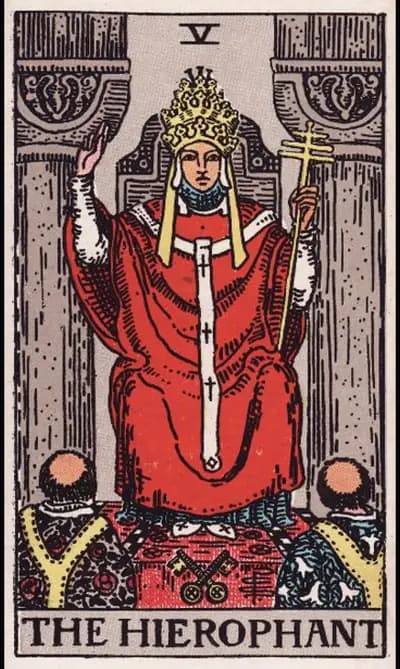
A pontiff in red robes and a golden triple crown sits between two grey pillars, hand raised in blessing; at his feet, two crossed keys and two tonsured monks.
The Hierophant sits between two grey pillars, plainer than the High Priestess’s. He wears a triple crown, which the tradition reads as three worlds or three degrees of knowledge. His left hand holds a cross with three bars. His right hand blesses, two fingers raised. At his feet lie two crossed keys, the keys of Saint Peter: they open and they close. Two tonsured monks face him, their backs to us. One wears roses on his robe, the other lilies, the flowers of the Magician’s garden: desire and purity come to listen side by side. Waite sees the Hierophant as outer religion, the faith of institutions, while the High Priestess keeps the secret knowledge.
The Hierophant upright
You don't have to figure it all out alone. Someone more experienced, a tradition, a framework that has proven itself can guide you now. Bring your question to a person who has walked this path, and truly listen to the answer.
Upright, the Hierophant tells you to look for a guide. A more experienced colleague, a serious course, a therapist, a group that shares your practice, an older relative: someone has already walked this road and can spare you detours. The card is about learning, not obeying.
It can also speak of the rites and commitments that mark a life: a ceremony, a degree, a contract, a promise made in front of others. Waite read marriage and alliance into it. The Hierophant reminds you that shared forms carry meaning: they give a frame to what you live. Bring your question to someone who knows, and really listen to the answer before you argue with it.
The Hierophant reversed
Everyone gets along, and it's sweet, maybe too sweet. By agreeing with all and forgiving yourself everything, you grow fragile. Keep the harmony, but find one demand again: one thing you won't let slide any more.
Reversed, the Hierophant follows Waite’s reading: concord and good company, but also too much softness and a kind of weakness. Everyone around you gets along, and it feels nice. But by agreeing on everything and forgiving yourself every slip, you lose your backbone. The frame slowly goes soft from the inside, and nobody notices. Keep the harmony, because it is worth something real. Just find one demand again: one thing you will no longer let slide, in others or in yourself.
In love
In love, the Hierophant speaks of commitment and shared values. It favours bonds built to last, joint plans, sometimes an official step. It also asks whether you share the same bearings: family, money, fidelity. If you are following a model of partnership out of habit, it invites you to ask whether that model still fits who you are.
Work and money
At work, the Hierophant favours teaching, institutions, and jobs built on advice and passing on knowledge. It is a good card for training, finding a mentor, or joining a solid organisation. With money, it prefers proven methods to gambles. Ask a professional before any big decision, and play by the rules.
As advice
As advice, the Hierophant asks you to find someone who knows, and to put one real question to them this week. Hear the whole answer. Only then decide what you keep from it. Learning from someone does not mean accepting everything they say.
Astrology and tradition
The Golden Dawn gives the Hierophant to Taurus. Taurus is a fixed earth sign, ruled by Venus, with the Moon exalted there. It is the sign of what lasts, of what you keep and hand down, of habits that turn into foundations. A tradition is exactly that: knowledge laid down layer by layer, slowly, like cultivated soil. The card carries the Hebrew letter Vav, the nail that joins.