What the card shows
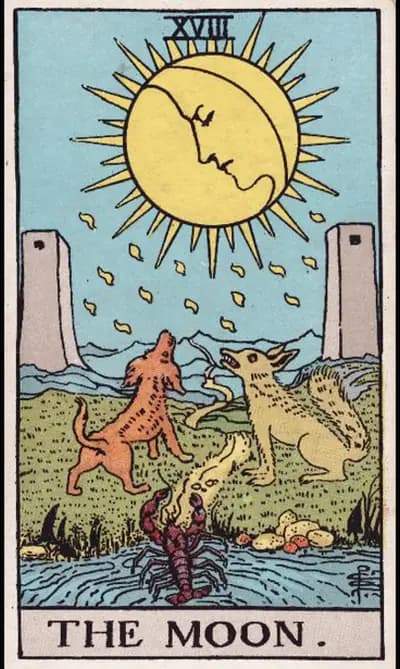
A moon with a face in profile sheds yellow drops; a dog and a wolf howl up at it, a crayfish climbs from the water between two grey towers.
Pamela Colman Smith's Moon shows a face in profile, eyes half closed, set inside a large rayed disc. Yellow drops shaped like yods fall towards the earth. Below, a crayfish crawls out of a pool: Waite saw in it something rising from the depths, lower even than the wild beast. On the bank, a dog and a wolf howl at the sky, the tame and the wild, which Waite read as the fears of the natural mind. Between them a path runs between two grey towers and climbs towards distant mountains. The road is there, but you only see it in pieces, by reflected light.
The Moon upright
Things aren't clear right now, and that isn't your failing. Move slowly, trust what you sense more than what you're told, and write down your dreams: what worries you at night is often trying to tell you something.
Upright, the Moon describes a time when things are not clear. A message you reread ten times to guess its tone, a situation at work where nobody tells you everything, a worry that swells in the evening and shrinks by morning. The card does not ask you to understand it all at once. It asks you to move slowly, as you would on a path at night.
Waite read it as hidden enemies, deception, fear and error. We keep the idea of uncertain ground, not of enemies. Trust what you sense more than what you are told, but check before you act. Write your dreams down: what worries you at night is often trying to tell you something true, in a language of symbols.
The Moon reversed
Things keep shifting and nobody says anything. A small deception, a promise that changes from one day to the next, a silence that lasts. It isn't serious, but it's unstable: build nothing on it until someone speaks to you clearly.
Reversed, the Moon speaks of an instability that is smaller but stubborn. Things keep shifting and nobody says anything: a promise that changes from one day to the next, a silence that drags on, a small deception that will not name itself. It is not serious, but it is not solid either.
Waite, in 1910, read the reversal as instability, inconstancy, silence and deception of a lesser kind. Build nothing on it until someone speaks to you plainly. Many readers also see the fog lifting here, and it does lift the day you ask the straight question.
In love
In love, the Moon speaks of doubts and things left unsaid. You imagine what the other person thinks, read meaning into their silences, and your imagination fills the gaps, often with your fears. The card does not say you are being deceived. It says you are missing information. Ask one simple, direct question and let them answer, rather than building scenarios at night.
Work and money
At work, the Moon flags a blurry situation: a project with vague edges, a restructuring nobody explains, a colleague who is hard to read. It advises keeping written records, getting instructions clarified and signing nothing you do not understand. With money, it warns against decisions made in anxiety or on the strength of a promise that sounds too good.
As advice
As advice, the Moon says: separate what you know from what you imagine. Two columns, once again. Act only on the first. And keep a notebook by the bed: a dream written down on waking sometimes tells you more than an hour of thinking.
Astrology and tradition
The Golden Dawn gives the Moon card to Pisces, the mutable water sign and last of the zodiac, ruled by Jupiter in the tradition, with Venus exalted. Pisces is the sign where boundaries dissolve: dream and waking, self and other. The crayfish climbing out of the water recalls that watery world. Its Hebrew letter is Qoph, often read as the back of the head: the part of us that works while we sleep.