What the card shows
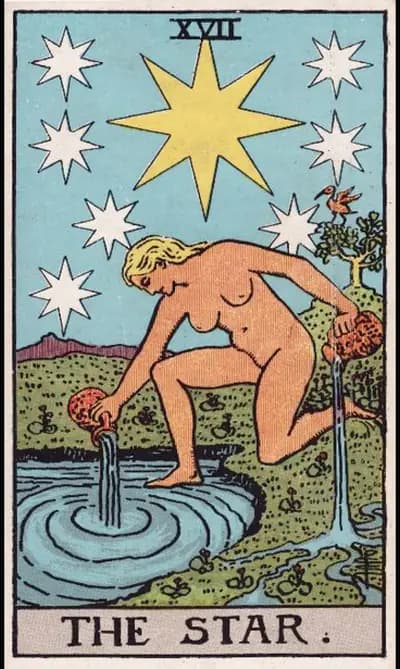
A naked woman, one knee on the grass and one foot in the water, pours out two red jugs; above her, a large yellow star and seven small white stars.
Pamela Colman Smith paints a naked woman, without ornament or defence, one knee on the earth and one foot resting on the water. She pours out two jugs. One empties into the pool and feeds the flow of inner life; the other spills onto the land in small rivulets, which many count as five, like the five senses. Above her shines a large yellow eight-pointed star, ringed by seven small white ones. On the right a bird perches in a tree: many see an ibis, bird of Thoth, the god of wisdom. Everything is open, nothing hidden. After the Tower, this is the first calm.
The Star upright
Something was taken from you, or left you, and you feel alone with the lack. Hope doesn't erase it, but it is there beside it: a small light that asks for nothing. Drink water, sleep, and let it come back in its own time.
Upright, the Star is about afterwards. After a loss, a break-up, a stretch when you gave more than you had. The lack is there, and the card does not pretend otherwise. But beside it something is lighting up again: the wish to start a project, a morning that feels less heavy, a conversation that does you good. The Star's hope is not a promise; it is a presence.
Waite gives two readings: loss, privation and abandonment, and another that speaks of hope and bright prospects. Book T leans to hope, and we keep both together. The card asks for simple things: drink water, sleep, walk, and let trust come back at its own pace, without hurrying it.
The Star reversed
You hold yourself very high so as not to feel how little you can do. Pride covers the powerlessness, and it isolates you. Come down a step: admit what escapes you, and ask plainly for what you need.
Reversed, the Star shows a hope that has closed up. You hold yourself very straight, very high, so as not to feel how little you can change what is happening. Pride covers the powerlessness, and it isolates you: you turn down help, say everything is fine, and stop seeing what could do you good.
Waite, in 1910, read the reversal as arrogance, haughtiness and powerlessness, and our reading keeps its core. Come down a step. Admit what is out of your hands, and ask plainly for what you need.
In love
In love, the Star speaks of a heart mending and of sincerity. After a disappointment, it marks the moment you can open up again, without armour. In a couple, it asks you both to show yourselves as you are, without games. With someone new, it speaks of a simple, trusting bond. It promises no one in particular. It says your heart is ready to receive.
Work and money
At work, the Star supports projects with meaning and fresh starts after a setback. It suits creative work, care work, anything that asks you to inspire others. It is a good moment to show your work, send in an application or go back to studying. With money, it advises reasonable trust: rebuild step by step, without risky bets.
As advice
As advice, the Star says: look after your source. One simple thing each day that fills you up instead of draining you. Then share some of what comes back, without giving it all away: the woman on the card keeps one jug for the earth and one for the water.
Astrology and tradition
The Golden Dawn gives the Star to Aquarius, and the picture shows why: a figure pouring water, like the Water Bearer of the zodiac. Aquarius is a fixed air sign, ruled by Saturn in the tradition. Fixed air means ideas that last, ideals, the picture of a shared future. Saturn adds patience: Aquarian hope is not a passing dream but a trust that holds over the long run.