What the card shows
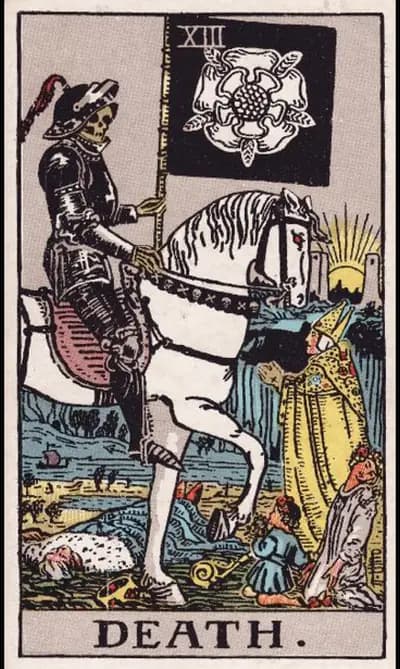
A skeleton in black armour rides a white horse with a black banner bearing a white rose; a king lies fallen, a bishop prays, far off, a sun shines between two towers.
Pamela Colman Smith draws Death as a skeleton in black armour on a white horse. It does not gallop; it walks. Its black banner carries a white five-petalled rose, which the tradition reads as life going on beneath the ending. Each figure meets it differently: a king has fallen and his crown lies on the ground, a mitred bishop waits with joined hands, a young woman turns her face away, a child looks up without fear. No rank escapes it. In the distance a boat drifts down the river, and a sun shines between two towers on the horizon. Waite calls it the sun of immortality, and many see a dawn.
Death upright
Something in your life has run its course: a habit, a role, a relationship as it used to be. Let it fall away without holding on. This is not a bare loss; it clears room for what is already starting to show.
Upright, Death says something has run its course. Not necessarily a disaster: a job you have outgrown, a friendship that no longer feeds anyone, a way of being a couple that no longer fits you, a version of yourself kept out of habit. The card asks you to let go of what is already dead instead of keeping it alive by force.
The tradition stresses change more than loss. Book T, the Golden Dawn's text, reads it as time, transformation and involuntary change. An ending lived well makes room: time, energy and space in your life for what is already starting to show. Grieving the old shape is part of it, and it is allowed to take time.
Death reversed
You are holding on to what has already ended, afraid of the empty space after. The ending happens anyway, only slowly, and it wears you down. Ask yourself what you are protecting by not letting go.
Reversed, the card describes an ending you refuse. You keep going to a job that dims you, you restart a story that is over, you keep the objects, rituals and passwords of a life you have already left. The ending happens anyway, only slowly, and it wears you down.
Waite read it as inertia, sleep and lethargy: a life on pause. The fear of the empty space is often bigger than the space itself. Ask what you are protecting by not letting go, and what you would do with the time it frees.
In love
In love, Death speaks of an ending or a shedding of skin. For a couple, it is often the end of one way of being together: the early days are gone, and either something new grows or the bond wears out. For someone single, it is the end of an old pattern, the same kind of partner, the same hurt. The card does not decide a break-up for you. It asks what is already over.
Work and money
At work, the card goes with the end of a cycle: a contract ending, a role disappearing, an urge to change careers that will not go away. It advises preparing what comes next rather than stretching out what is fading. With money, it says close what costs you without serving you: a forgotten subscription, a spending habit left over from another life.
As advice
As advice, Death says: list what you still carry out of habit. Pick one thing and let it go this week, cleanly, with a thank you if it served you. The empty space afterwards is not a failure. It is room.
Astrology and tradition
The Golden Dawn gives card XIII to Scorpio, the fixed water sign, eighth of the zodiac and ruled by Mars in the tradition. Scorpio is the sign of things that die in order to change: the Sun passes through it in autumn, when leaves fall and sap draws back down into the ground. Its Hebrew letter is Nun, the fish. Fixed water: what ends does not vanish, it changes form.