What the card shows
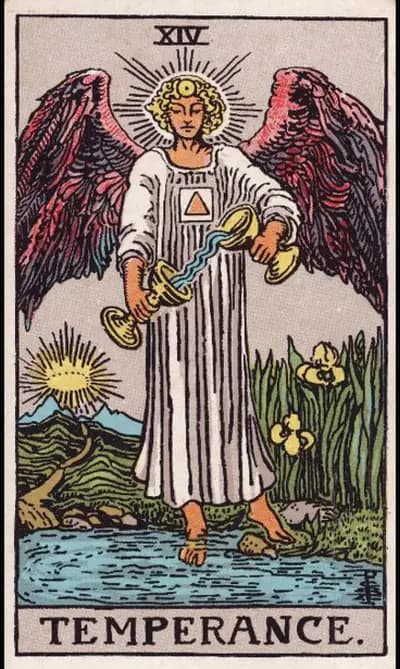
An angel with large red wings pours water from one gold cup into another, one foot in the pool and one on the bank; yellow irises bloom on the right.
Pamela Colman Smith's angel has large red wings and a white robe. It pours water from one cup into the other, and the stream passes between them without losing a drop: the tradition sees a patient, precise blending. One foot is in the pool, the other on the bank, between feeling and the solid world. On the chest, a triangle within a square, and above it Hebrew letters the tradition reads as the divine name. A solar disc shines on the forehead. On the right grow yellow irises, in which many see a nod to Iris, messenger of the gods and goddess of the rainbow. In the background a path climbs towards two peaks where a crown-shaped light is rising.
Temperance upright
You don't have to choose between two sides of your life: you can blend them, a little at a time. Slow the pace and adjust a bit each day, work and rest, drive and caution. Balance comes from pouring gently, not all at once.
Upright, Temperance speaks of a balance built little by little. You do not have to choose between two sides of your life: you can measure them out. A heavy week calls for a free evening. An urge to change everything gets tested for a month first. An argument settles better in three calm conversations than in one big scene.
The card also speaks of recovering after a stretch of excess: finding your rhythm again, coming back to the right measure, one meal, one night, one week at a time. Waite read it as economy, moderation, good management and the art of accommodation. Nothing spectacular here, only an everyday wisdom that pours gently rather than all at once.
Temperance reversed
Rival interests are fighting over your place: a group, an institution, people pulling each their own way. The bond is coming apart. You don't have to reconcile everyone: see what you still belong to, and what you no longer do.
Reversed, Temperance stops blending anything. Rival interests fight over your place: a family where everyone pulls their own way, a divided team, a club or an institution that asks more than it gives. The bond comes apart, and you wear yourself out playing go-between, or swing from one extreme to the other.
Waite, in 1910, read the reversal as church and clergy matters, disunion and competing interests; we keep the disunion. You do not have to reconcile everyone. Look at what you still truly belong to, and what you no longer do. Then find a measure that is your own.
In love
In love, Temperance speaks of a bond that adjusts. Each person takes a step, and no one dissolves into the other. For a couple, it is time to find a shared rhythm: time together, time alone, friends, family. With someone new, it advises going slowly: let the bond form over weeks, without telling everything or asking for everything on the first date.
Work and money
At work, Temperance favours cooperation and long-term projects. It suits mediation and coordination, anything that asks different people to work together. With money, it speaks of simple management: a budget kept, regular saving, spending adjusted bit by bit rather than in big swings. Progress is slow, but it holds over time.
As advice
As advice, Temperance says: change one thing at a time, a little each day. Before a big decision, mix several views, starting with your own. And when you feel yourself going too far one way, step back a notch, without punishing yourself.
Astrology and tradition
The Golden Dawn gives Temperance to Sagittarius, the mutable fire sign ruled by Jupiter. Mutable fire is fire that adapts: it does not burn everything down, it warms and transforms. Sagittarius aims far, like the archer, and the path on the card climbs towards the horizon. In the Golden Dawn, this card's path, the archer's arrow, pierces the rainbow called Qesheth. Jupiter brings a generous measure: growing without losing yourself in excess.