What the card shows
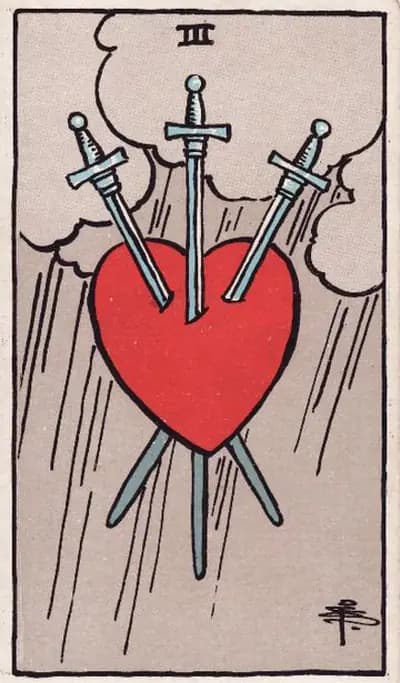
A red heart pierced by three swords, set against heavy grey clouds; slanting rain falls across the whole background.
Pamela Colman Smith drew one of the barest cards in the deck here: no figure at all, only a symbol. The red heart floats in the centre, as if pain had become the whole landscape. Three swords pass through it, two on the diagonal and one straight down, meeting in the middle. The tradition sees thoughts converging on a single wound. Behind it, heavy grey clouds fill the sky, and slanting rain falls across the whole card. Rain is often read as tears, but also as what washes: a downpour does not last. Nothing moves in the image. It is a moment of truth, held still.
Three of Swords upright
Something has hurt you: a word, a truth, a loss. No need to pretend you're already fine. This sorrow asks to be felt, cried, spoken aloud to someone you trust. It passes by going through it, the way rain does.
Upright, the Three of Swords describes pain that often arrives through words or truth: a message discovered, a sentence that cuts, an absence announced. Waite reads division, rupture, removal and delay. The card does not judge. It simply notes that a blow has landed.
What it asks is simple and hard: stop pretending you are already fine. Cry if you need to, talk to someone safe, write down what happened. Sorrow you refuse tends to come back through other doors, as tiredness or anger. Sorrow you feel ends up passing, like the rain in the picture. The Three is not an ending. It is the moment the wound is named, which is what lets it heal.
Three of Swords reversed
The pain gets tangled: you no longer know what happened or who was wrong. An error, a loss, and too many versions in your head. Don't try to understand it all yet. Write down the facts, only the facts, before you judge.
Reversed, the Three of Swords shows pain that gets tangled. You no longer know quite what happened, who said what, who was wrong. Several versions argue in your head, and each one reopens the cut. Waite, in 1910, read error, loss and confusion here. Our reading keeps that idea: the sorrow is there, but it circles without getting out. The card advises going back to the facts. Write down what actually happened, only that, and leave the verdict for later.
In love
In love, the Three of Swords speaks of heartache: an argument, a betrayal discovered, a separation, or just one sentence that hurt. It does not say whether the relationship will continue. It says the pain is real and needs to be acknowledged, by you and between you. If you are single, it can point to an old sorrow that still weighs on your choices.
Work and money
At work, the card can show a disappointment: a project turned down, harsh criticism, a team splitting, a departure that stings. It advises against replying in the heat of the moment. Let a day pass, then separate what is true in the criticism from what only hurts. With money, it asks you to face a loss rather than hide it.
As advice
The Three of Swords as advice: let the sorrow exist. Give it a moment, a person, a page. What you feel is not an overreaction. Sadness loses its force when you go through it, not when you go around it.
Astrology and tradition
Book T names this card the Lord of Sorrow. Its decan is Saturn in the middle third of Libra. Saturn is exalted in Libra, where it brings law, limits and unvarnished truth. In the sign of partnership, that becomes separation: a truth that cuts what no longer holds. Three is the number of action definitely begun, for good or ill. Here the pain is already under way.