What the card shows
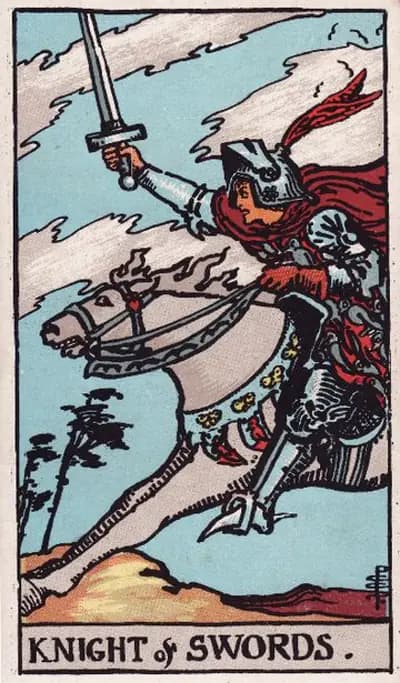
An armoured rider in a red cape gallops full tilt on a white horse, sword raised high; behind him, wind-bent trees and torn clouds.
An armoured knight, red cape streaming, charges on a white horse at full gallop, sword held high. The horse’s nostrils flare and its legs stretch out: the tradition makes it the fastest of the four Knights in the deck. Trees bend in the wind, clouds are torn apart, birds are swept along. The horse’s harness is decorated with butterflies and birds, the creatures of Air. Waite describes him riding in full course, as if scattering his enemies, and calls him the prototypical hero of romantic chivalry. The tradition reads the pure drive of thought, fast and unchecked.
Knight of Swords upright
You know exactly what you want and you're going for it. That speed is an asset: decide, send the message, make the cut. Just keep an eye on the people you pass along the way: precision matters as much as pace.
Upright, the Knight of Swords describes the energy of decision. You know exactly what you want and you go for it: you send the message, hand in your notice, defend your idea without hedging. Waite reads skill, bravery and capacity here, and also wrath and enmity when that force turns against someone.
That speed is a real asset. It unblocks situations that have bogged down and cuts hesitation short. The card only asks you to keep an eye on the people you pass: a fair point, said too sharply, can hurt for a long time. As a person, the Knight can be someone quick and in a hurry. Book T also sees news in the Knights, matters arriving or leaving.
Knight of Swords reversed
You're racing without knowing where, or your words leave faster than your thinking. Before you reply or drop everything, slow down: a cutting sentence is hard to take back, and momentum without a plan often ends in a detour.
Reversed, the Knight of Swords keeps his speed but loses his direction. You are racing without knowing where, changing plans every other day, or your words leave faster than your thinking. Waite, in 1910, read imprudence, incapacity and extravagance here, and our reading joins him. The card asks you to slow down before you reply or drop everything. A cutting sentence is hard to take back, and drive without a plan often ends in a detour. Breathe, reread, then go.
In love
In love, the Knight of Swords brings frank, fast energy: a direct declaration, a relationship that starts quickly, a conversation that clears the air. It can also describe someone brilliant but not very available emotionally. In an argument, it warns against words thrown too fast. Say what you think, but give the other person time to answer.
Work and money
At work, the card favours quick action: launching a project, defending a proposal, settling a question that has dragged on. It suits situations that call for courage and quick thinking. It warns against haste and pointless clashes with colleagues. With money, sign nothing in a rush: speed helps you decide, not check.
As advice
The Knight of Swords as advice: go straight for what you want, but aim before you speed up. Take ten minutes to check your plan and reread your message. Then charge. Precision matters as much as pace.
Astrology and tradition
In the Golden Dawn, the Knight corresponds to Book T’s mounted figure, here the Lord of the Wind and the Breezes. He is Fire of Air: the drive of Fire launched into the element of thought. That gives a mind that is fast and ardent, sometimes brutal, like a gust of wind. Book T assigns him a thirty-degree stretch of the zodiac, from late Taurus to late Gemini.