What the card shows
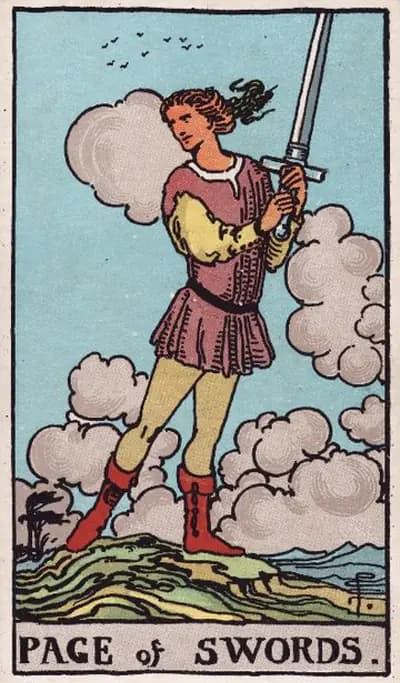
A young man in a pink tunic and red boots holds a sword raised in both hands on a hillock; grey clouds, wind in his hair, birds in the sky.
A young figure in a pink tunic and red boots stands on rough ground, sword raised in both hands. He is not striking: he is ready. Waite describes him as lithe and active, looking this way and that, as if an expected enemy might appear at any moment. The wind lifts his hair, clouds pile up, a flock of birds crosses the sky. Everything around him moves, like Air itself. He stands on high ground, which gives him a view. His body faces one way and his gaze another: the tradition reads vigilance, and also a mind torn between several leads.
Page of Swords upright
You want to understand, so ask the questions, even the slightly awkward ones. Read, look things up, watch before you decide. Your mind is quick right now: keep your eyes open, answers come fast when you stay alert.
Upright, the Page of Swords describes sharp curiosity. You want to understand a situation, so you ask questions, read, look things up. Waite reads oversight, vigilance and close examination here. It is the card of someone starting a course, preparing for an interview, or running a small investigation before deciding.
The card encourages slightly awkward questions: asking a teacher to explain again, a bank to break down its fees, a friend what she really meant. It advises watching before you cut. As a person, the Page can be someone young, or an adult with a quick, slightly impatient mind. Book T sees ideas or opinions in the Pages more than people. Here, a new idea is arriving.
Page of Swords reversed
Curiosity slides into gossip or words thrown out too fast. You talk a lot about what you would do without doing it. Before you reply, sleep on it, and check what you are told.
Reversed, the Page of Swords keeps its quickness, but it scatters. Curiosity slides into gossip, words leave before thought, and there is a lot of talk about what one would do without doing it. You may also receive inaccurate information, or be the subject of a rumour. Waite, in 1910, read the unforeseen and an unprepared state here; he added sickness, which we do not read. Before you reply, sleep on it, and check what you are told before you repeat it.
In love
In love, the Page of Swords speaks of communication: messages, questions, the wish to understand the other person. It favours frank conversations and beginnings where people get to know each other through words. It can also show mistrust, the urge to check up and keep watch. The card advises asking directly what you want to know. An honest question beats a quiet investigation.
Work and money
At work, the card favours learning, research and analysis: a new skill, a file to study, a field to keep watch on. It suits work in writing, investigation and communication. It advises checking the facts carefully before passing them on. With money, compare, do your research, and read the terms before you commit.
As advice
The Page of Swords as advice: ask the question. The one you don’t dare ask, the one that seems naive. Then listen to the whole answer before you judge. Curiosity is your strength as long as it seeks to understand rather than to spread.
Astrology and tradition
In the Golden Dawn, the Page corresponds to Book T’s Princess, here the Princess of the Rushing Winds. She is Earth of Air: the most concrete part of a moving element. This is the idea beginning to take shape, the observation turning into a fact. Book T gives the Princesses no decan: they rule a quarter of the sky around the pole and serve as the throne of the Ace.