What the card shows
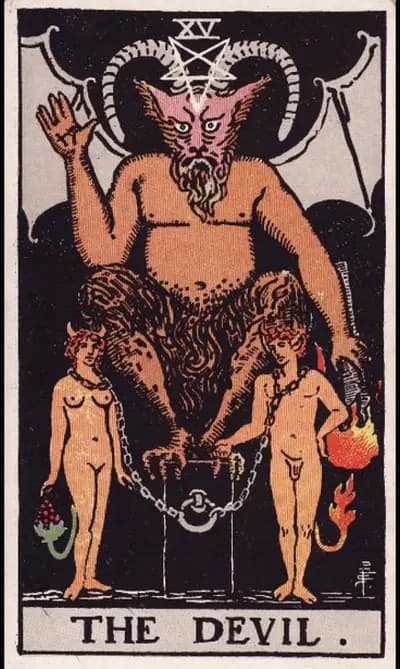
A horned creature with bat wings, torch held low, looms over two naked humans chained by the neck to its black block, the chains hanging loose.
Pamela Colman Smith's Devil has goat's horns and bat's wings and squats on a black block. An inverted pentagram marks its brow. Its right hand is raised, palm open; its left holds a torch pointing at the ground. Chained to the block stand a naked man and woman, with small horns of their own. Her tail ends in a bunch of grapes, his in a flame: desire and passion ripened to excess. The tradition sees in them the couple from the Lovers, fallen under a different law. The detail that matters: the chains around their necks are loose. They could lift them off.
The Devil upright
Something stronger than your will has hold of you, and you wear yourself out fighting it: a desire, a pressure, someone who weighs on you. It won't settle in a day. Name what constrains you, then what still depends on you.
Upright, the Devil speaks of a force stronger than your will of the moment. A craving that comes back every evening, a screen you cannot put down, a relationship where you always give in, a job that holds you through the pay cheque. You wear yourself out fighting it, and the fight itself keeps you in the loop.
Waite read the card as violence, intense effort, force and fate; Book T reads it as materiality and obsession. We keep the idea of a hold, not of a destiny. It will not settle in a day. Start by naming what constrains you, without shame, then what still depends on you. Desire is not the problem. Losing the choice is.
The Devil reversed
You no longer see what harms you, and what holds you has grown smaller and pettier, yet it still holds. That weakness isn't a fault. Ask someone you trust what they see, there where you have stopped looking.
Reversed, the Devil does not quite let go. What holds you shrinks and grows pettier: a habit you no longer notice, a grudge you keep fed, a dependency you call just a thing I do. You no longer see what harms you, and that is exactly what keeps it in place. Waite, in 1910, read the reversal as weakness, pettiness and blindness.
Some readers see the first sign of release here, and release does start the day you see the chain. That weakness is not a fault. Ask someone you trust what they see, there where you have stopped looking.
In love
In love, the Devil speaks of strong desire and of dependency. The attraction is real, sometimes burning, but ask yourself if you stay by choice or out of fear of the lack. Jealousy, control, going back again and again to someone who hurts you: the card names these plainly. If you feel unsafe, talk to someone and get help; cards are not enough for that.
Work and money
At work, the Devil shows golden handcuffs: a salary that keeps you in a job that wears you down, an ambition that eats your evenings, a manager who rules through fear. With money, it speaks of credit, compulsive buying, spending to make up for something. It promises neither ruin nor fortune. It asks what you are really trading for what you earn.
As advice
As advice, the Devil says: look at the chain directly. Write down what holds you, when it comes back and what it really gives you. Then find the smallest act that loosens it by one link: a day without, a no, a request for help.
Astrology and tradition
The Golden Dawn gives the Devil to Capricorn, and its goat's horns say so. Capricorn is a cardinal earth sign, ruled by Saturn, with Mars exalted. Saturn gives structure, time and limits; Mars gives ambition and force. Lived well, they build. When they harden, structure turns into a cage and ambition into a hold. Its Hebrew letter is Ayin, the eye: the card asks you to see clearly.