What the card shows
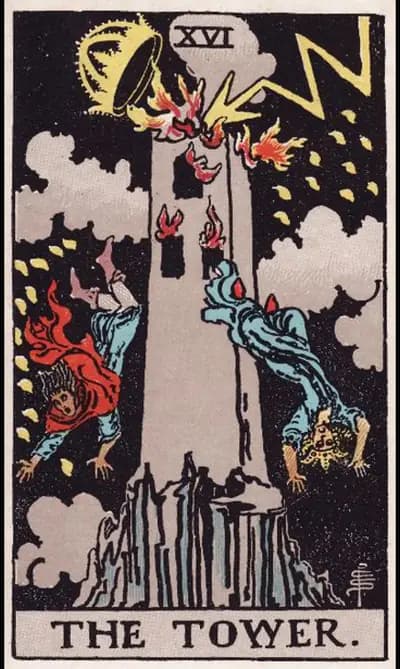
A yellow lightning bolt strikes a grey tower on a rock: the gold crown topples, flames burst from the windows, two people fall headfirst.
Pamela Colman Smith sets her tower alone on a rocky peak against a black sky. Lightning strikes the top and knocks off its golden crown: the tradition reads this as pride, or false certainty, cut off at a stroke. Flames burst from three windows. Two people fall headfirst, one crowned and one not: the shock does not care about rank. Around them float small flames shaped like yods, the Hebrew letter, usually counted as twenty-two and linked to the twenty-two major arcana. The image is violent, but nothing in it was built to last. No door can be seen.
The Tower upright
Something you thought was solid cracks all at once: a plan, a belief, a way of pretending. It is abrupt, but what falls was already hollow. Let it go and look at what is still standing: that is what you rebuild on.
Upright, the Tower describes a moment when something gives way all at once. A plan you counted on stops, a belief about yourself or someone else cracks, a lie comes out. It is abrupt, and the card does not pretend otherwise. But what falls was often already hollow: you sensed it without wanting to see it.
Waite read the card as distress, adversity, deception and unforeseen catastrophe. We read no coming misfortune here: the card describes a structure that no longer held. After the shock comes the sorting. Look at what is still standing: your real friendships, your skills, what you know now. That is what you rebuild on, closer to what is true.
The Tower reversed
You can feel things cracking, yet you keep holding the walls up. Delaying the collapse does not make it gentler, only longer. Look at what no longer holds before it costs you more.
Reversed, the Tower describes a collapse held back by sheer effort. You can feel things cracking, at work, in your relationship or in a belief, but you patch, delay and pretend. Putting off the fall does not make it gentler, only longer, and it costs you energy every day.
Waite, in 1910, read the reversal as the same troubles in a lesser degree, or as a kind of oppression. Look at what no longer holds. A change you choose, even a hard one, costs less than a wall that finally falls on its own.
In love
In love, the Tower speaks of a crisis or a revelation. A fight that strips away the masks, a truth finally spoken, an illusion about the other person that collapses. It is not necessarily a break-up: some couples rebuild on more honest ground. For someone single, it can be an attraction that turns everything upside down. The card does not pick the outcome.
Work and money
At work, the card goes with restructurings, cancelled projects and sudden rethinks. It advises not betting everything on a single structure and keeping your network alive. With money, it asks you to check what rests on sand: a verbal promise, an investment you do not understand. It predicts no loss. It asks for care.
As advice
As advice, the Tower says: do not wait for the lightning to look at the cracks. Name the thing in your life you know is false right now. If it has to fall, prepare for afterwards: who to talk to, what to lean on, what you want to keep.
Astrology and tradition
The Golden Dawn gives the Tower to Mars, the planet of force, cutting and sudden action. Mars is fire that strikes: the lightning bolt, the blade, the abrupt decision. On the card, that energy brings down whatever was blocking the way. Its Hebrew letter is Peh, the mouth: speech that bursts out, the truth said all at once. Mars destroys, but it also clears space to act.